
The Out-of-Office That’s Been On Since 2019
You booked the day off. You still checked email before nine. If you can’t relax on days off, the reason is mechanical, not moral. Here is what is happening.

You booked the day off. You still checked email before nine. If you can’t relax on days off, the reason is mechanical, not moral. Here is what is happening.
Absorbing other people’s moods is automatic and measurable. The catching is not the cost. What you do about it afterwards is, and that part is optional.
Most research on household labor counts chores. One study counted something else: who holds the mental checklist. The women who scored highest on that measure weren’t just tired — they showed a specific, measurable dip in wellbeing that chore-counting never captured.
The guilt hangover after a boundary isn’t proof you were wrong. A 2012 study found the two words that hold, and the ones that quietly invite a renegotiation.

A work boundaries email problem usually gets filed under willpower. The research says otherwise: answering a “quick question” costs measurable attention, and the pull to answer fast has its own name and its own laboratory.

People pleasing with family usually shows up first as an edit: a true answer typed, then deleted for something safer. A psychologist has measured that pattern for three decades. What her 126 studies found is not quite what circulates.
Why do I apologize for everything, even for things that are not my fault? A 2010 diary study found the real reason, and low confidence is not it at all.
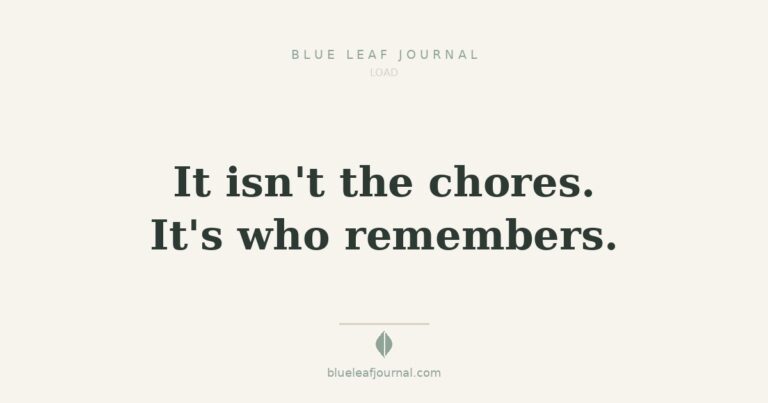
The division of household labor has four phases and only one is visible. A sociologist measured which two land on you, and what to write down tonight.