
Someone Says Your Name and the Sentence You Had Is Gone
Mind · The Reading Room, Vol. 2 · 8 min read · What the pressure research found about who actually goes blank, why it is the wrong people, and five words for the four seconds
Based on the published research of Sian Leah Beilock, PhD — cognitive scientist and President of Dartmouth College, previously Professor of Psychology at the University of Chicago and President of Barnard College — with Prof. Thomas H. Carr, PhD, Michigan State University. Office of the President, Dartmouth · sianbeilock.com · @sianbeilock
Why do I go blank in meetings is a question with an uncomfortable answer: in the pressure research, the people who lost the most ground were the ones with the most capacity to lose.
I had it. I had the whole thing, three points, in order, with the number from the second slide. I had been holding it for eleven minutes waiting for a gap.
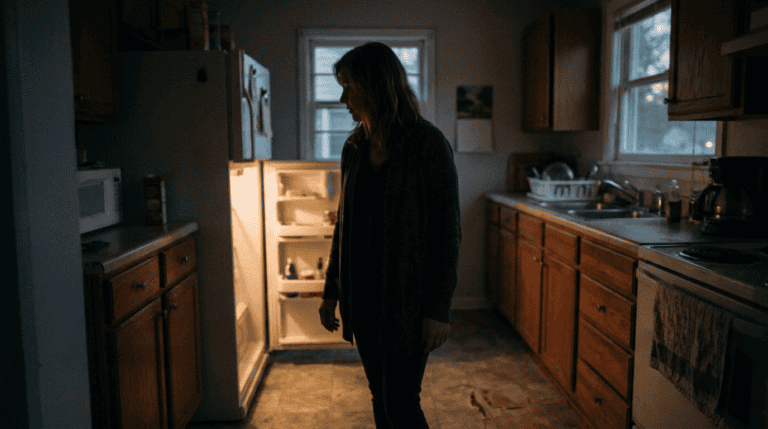
Then somebody said “Jo, you’ve looked at this,” and eleven faces turned, and what came out of me was “Yes. So. The, ah.” Four seconds of nothing. Then a sentence that was technically about the topic and served no purpose whatsoever.
I got in the car afterwards and did what everybody does, which is deliver the excellent version of the answer to the windscreen, fluently, at length, to nobody. What follows is a reading of published research on that four seconds; I am not a clinician, the findings belong to Sian Beilock and Thomas Carr, and only the plain-English version and the car park are mine.
The short answer: why do I go blank in meetings has a mechanism, and it is not the one you assume. Pressure does not slow everybody down equally. In a 2005 study, performance pressure harmed the people with the highest working memory capacity most, because the pressure consumed exactly the resource those people were relying on to perform well.¹ The people who sailed through were the ones who had not been using much capacity in the first place. Going blank is not evidence that you have less. It is a signature of having been using more.
I have started calling the thing that arrives the second job, because that is literally what it is: the moment the room turns, a second task appears in the same workspace the first one was using. Monitoring. It is worth having a name for, because “I went blank” sounds like a verdict on you and “the second job took the room” sounds like what actually happened.
There is a name worth having for what happens in those four seconds, because at some point you will want to say it out loud to somebody: the second job. The first job is the answer. The second job is monitoring how the answer is landing while you deliver it. They run in the same small space, and the second one wins.
The skim version
- Beilock and Carr tested whether pressure affects everybody the same way. It does not.¹
- Only the people with high working memory capacity showed a real drop under pressure.¹
- Their explanation was that pressure consumes the very capacity that high performers depend on.¹
- The drop was largest on the problems with the greatest cognitive demand. The easy ones held up fine.¹
- Which means the blank arrives on the question you had most to say about, not the one you knew least.
The source for this piece
Sian Leah Beilock, PhD
President of Dartmouth College and a cognitive scientist who has spent her career on why skilled people underperform under pressure. Previously President of Barnard College and Professor of Psychology at the University of Chicago, where she ran the Human Performance Lab. Elected to the American Academy of Arts and Sciences. Her co-author Prof. Thomas H. Carr (ResearchGate · LinkedIn) is Professor Emeritus of Psychology at Michigan State University.
What we read: Beilock & Carr, “When High-Powered People Fail: Working Memory and ‘Choking Under Pressure’ in Math,” Psychological Science (2005), linked in full at the end of this article.1 Her book for general readers on this research is Choke.
Where to follow her work: Dartmouth · sianbeilock.com · @sianbeilock · American Academy of Arts and Sciences
Why do I go blank in meetings when I know the answer?
Because knowing the answer and retrieving it under observation are two different operations, and only one of them is protected.
Working memory is the small, expensive workspace where you hold things while you do something with them. The number from the second slide, the shape of the argument, the fact that Priya already tried this in March. Holding all of that is what allows an answer to arrive assembled rather than in pieces.
The moment eleven faces turn, a second job appears in the same workspace. Monitoring. How this is landing. Whether that was too long. Whether the pause has now become the thing everyone is noticing.
The workspace does not get bigger to accommodate the second job. It divides. And what gets dropped first is the thing that was taking up the most room, which was the good answer.
The part of the finding that is genuinely uncomfortable
Sian Beilock and Thomas Carr set out to find who chokes. They gave people problems of varying difficulty, applied performance pressure, and split the results by how much working memory capacity each person had.¹
The people with high capacity dropped. The people with lower capacity did not, much.
Their phrasing was that performance pressure harms individuals most qualified to succeed, by consuming the working memory capacity that they rely on for their superior performance.¹ And the losses concentrated on the problems with the greatest demands, which is the detail that reorganises everything.¹
So the blank does not turn up on the routine question. It turns up on the one where you were holding four things at once, which is to say the one you were most qualified to answer. The woman who has thought about it hardest is the woman most likely to lose it at the moment of asking. If that sounds like a design flaw, it is, and it is not yours.
Between us
I am leaning hard on one study and I want you to see its shape before you lean on it too. It is Beilock and Carr, published in Psychological Science in 2005, five pages, and it has held up well enough to be one of the more replicated findings in this corner of the field.¹
Being fair about it: the participants were undergraduates and the task was mathematics under laboratory pressure. Not a Thursday operations review, not eleven colleagues, and not one woman of fifty-three with an appraisal cycle in her peripheral vision. The mechanism generalises well and I believe it does. The specific size of the effect in your meeting room is not something anybody has measured, and I would rather tell you that than dress a lab result up as your life.
If the four seconds is only the visible part, and the real cost is the forty minutes in the car afterwards, that is a separate ledger. The Quiet Audit is a private ten-minute pass through what you carry out of a room. Start here.
Not knowing, and going blank, look identical from the outside
They are not the same thing, and confusing them is what turns one bad four seconds into a story about competence.
| Not knowing | Going blank | |
|---|---|---|
| Where it shows up | On unfamiliar ground | On the question you had most to say about |
| What happens after | Nothing. You go and find out. | The full answer arrives, fluently, in the car |
| Who it happens to | Anyone, on anything they have not covered | Disproportionately, the people with most capacity |
| What actually helps | Preparation | Freeing the workspace, not filling it further |
The bottom-right cell is where most advice goes wrong. Preparing harder for a meeting where you already knew the answer adds material to a workspace that was already full when it failed. Rehearsing it beforehand does something similar, and the replay afterwards is its own machine.
Five Things That Look Like This and Are Not This
Everything above protects the finding. This bit is for you, and it is the part most articles leave out, because it involves admitting they might not be describing you.
Five ordinary things produce word-finding trouble and a blank under pressure that feels, from the inside, exactly like the second job. None of them is exotic. All five are worth raising rather than assuming.
- An underactive thyroid. Slowed retrieval arrives with cold, dry skin, weight change and a fatigue a weekend does not touch.
- Sleep apnoea, or several years of short sleep. The tell is that it is worst in the morning, and that somebody has mentioned your breathing.
- Low B12 or low ferritin. Common at this age, quick to check, and usually accompanied by breathlessness on stairs rather than by anything mental.
- The perimenopausal word-retrieval pattern. It fluctuates rather than steadily worsening, and it turns up in ordinary conversation as well as under observation.
- Medication with an anticholinergic load. Some antihistamines, some bladder and sleep medicines. The clue is that it started within weeks of a new prescription.
None of these rules the second job in, and none of them rules anything else out. They stack, which is why a busy quarter plus untreated apnoea produces a much worse four seconds than either would alone. These are questions worth putting to a clinician, not a list you can clear yourself on.
Who Else Has Measured This
One study is never enough, and the gap in this one is real: undergraduates doing mathematics is not a Thursday operations review. Three other groups have come at the same mechanism from different directions.
Prof. Michael W. Eysenck (Research Portal · Wikipedia · ResearchGate), Emeritus Professor of Psychology at Royal Holloway, University of London, and Prof. Nazanin Derakshan (Faculty · Google Scholar · X) set out attentional control theory in Emotion in 2007: anxiety consumes the central executive, and the damage shows up in holding off distraction and switching between tasks rather than in what you know.²
Prof. Randall W. Engle (Faculty · Lab site · Wikipedia), at the Georgia Institute of Technology, spent a career establishing that working memory capacity is essentially executive attention — the ability to keep one thing in mind while something else competes for the space.³
Prof. Mark H. Ashcraft (1949–2022, in memoriam — Wikipedia), at the University of Nevada, Las Vegas, found the same shape in mathematics anxiety: the anxiety occupies working memory, and performance falls on exactly the problems that needed working memory most.&sup4;
Four groups, four methods, one direction. What fails under observation is not the knowledge. It is the space the knowledge was being assembled in.
The blank arrives where you had most to say.
What This Actually Changes
Not what you do in the meeting. That comes in a moment, and it is small. What it changes is the sentence you have been saying in the car.
That sentence is usually a version of I am losing it, and it rests on one piece of evidence: the gap was visible and everybody saw it. The research supplies the other half of the evidence, which was never visible to anyone. The gap opened because the space was full. It was full because you were holding four things at once. You were holding four things at once because you had thought about the question harder than anybody else in the room.
That is the whole reframe, and it is worth more than the technique. The four seconds is not evidence that you have less capacity than the people who answered smoothly. It is evidence that the second job walked into a workspace that was already carrying something worth protecting.
It also predicts something useful. If the mechanism is space rather than knowledge, the fix is not to know more before the meeting. It is to be holding less during it.
When this belongs with a doctor
Book an appointment rather than reading another article if the blank is getting steadily worse rather than varying with the room; if it happens in ordinary conversation and not only under observation; if it involves getting lost in familiar places, or losing the thread of sequences you have done for years; if somebody else raised it before you did; or if it arrived alongside new headaches, vision changes, or weakness on one side.
What to Say, and What You Will Probably Hear Back
One sentence is rarely enough, because there is a standard reply waiting for it. Here is the sentence, the reply, and the second line. Short enough to read off a phone.
For whoever runs the meeting
Say: “Can you flag the item you want me on, or send the question the day before? You get a much better answer from me when I am not assembling it live.”
If you hear “you will be fine on the day”: “Probably. I would still rather spend the time on the answer than on the retrieval.”
Neither is a confession and neither asks for an allowance. They are process requests, and most people say yes without thinking about it twice.
If what you want to take into that conversation is a clear account of what you have actually been carrying — rather than the memory of one bad Thursday — the Quiet Audit is ten private minutes on exactly that. No programme, no advice, nobody sees your answers. Start here.
Five words for the four seconds
Say the pause out loud. “Give me a second.” Then take it.
That is the whole move and I know how small it looks written down. The reason it works is mechanical. During an unexplained silence, part of your workspace is spent managing the silence: how long it has been, what people are concluding, whether to just start talking. Naming the pause hands that job to the room. The silence becomes a stated thing rather than a live problem, and the capacity that was policing it comes back.
Three seconds is usually all it takes, because the answer was never gone. It was displaced.
The second half, if you want it, is to keep a pen moving during the meeting and write one word for whatever you are holding. Not notes. One word. It moves the thing you are holding out of the expensive workspace and onto paper, which is where it is safe when eleven faces turn.
What is not worth doing is the debrief in the car. It feels like preparation and it is a thought presenting itself as a finding, which is a different problem and a much bigger one.
Questions worth having an answer to
Why do I go blank in meetings?
Because two jobs are competing for the same small workspace: producing the answer, and monitoring how it lands. In a 2005 study by Sian Beilock and Thomas Carr, performance pressure damaged the people with the highest working memory capacity most, and the damage concentrated on the problems with the greatest cognitive demands.¹ The blank therefore arrives on the question you had most to say about, not the one you knew least. It is a signature of having been using more capacity, not less.
Is this a memory problem?
It does not look like one. The information comes back intact twenty minutes later, which is not what a memory failure does. What failed was retrieval under load, and the load was the observation rather than the material.
Why is it worse now than it was at thirty-five?
The honest answer is that this study does not tell us, because it did not compare age groups. What has changed since thirty-five, for most women reading this, is how much else is being held at once, and holding more is exactly the condition under which the effect was largest.
Does more preparation fix it?
For not knowing, yes. For going blank, it can make things worse, because a bigger prepared structure is a bigger thing to be holding when the interruption arrives. Preparing one sentence beats preparing five.
Should I say something to my manager about it?
You can, and there is a version that costs you nothing: ask for the question in advance, or for the agenda item to be flagged. That is a process request rather than a confession, and most people say yes without thinking about it twice.
The one move
Next time the room turns and the sentence goes, say “give me a second” out loud, and then actually take it. Three seconds, out loud, before you start. That is the entire instruction.
Three seconds, out loud, before you begin. Nothing else about the meeting has to change.
Where to Go Next
In order, and each for a reason.
1. If the four seconds is the small part and the drive home is the expensive part, start with the replay machine and why it runs at all — that is the same capacity being spent a second time, hours later.
2. Then the rehearsal that happens beforehand, because preparing harder is the intuitive fix and it fills the workspace that failed.
3. Then the difference between a thought and a finding, which is what turns one bad four seconds into a verdict about you.
The room will turn again and the sentence will probably go again. It is worth knowing what it means when it does.
References
1. Beilock, S. L., & Carr, T. H. (2005). When High-Powered People Fail: Working Memory and “Choking Under Pressure” in Math. Psychological Science, 16(2), 101-105. Read the study
2. Eysenck, M. W., Derakshan, N., Santos, R., & Calvo, M. G. (2007). Anxiety and cognitive performance: Attentional control theory. Emotion, 7(2), 336-353. Read the paper
3. Engle, R. W. (2002). Working Memory Capacity as Executive Attention. Current Directions in Psychological Science, 11(1), 19-23. Read the paper
4. Ashcraft, M. H., & Kirk, E. P. (2001). The relationships among working memory, math anxiety, and performance. Journal of Experimental Psychology: General, 130(2), 224-237. Read the paper
On the researcher. Sian Leah Beilock is a cognitive scientist, not a physician: her doctorate is a research degree in psychology and kinesiology, and nothing in her published work is clinical advice. Her faculty page sits with Dartmouth’s Department of Psychological and Brain Sciences, where she is a member of the faculty alongside serving as the college’s President.
Sourcing, disclosure and disclaimers
This is not medical advice. Blue Leaf Journal publishes general information for a general readership. Nothing here is a diagnosis, a treatment recommendation, or a substitute for care from a clinician who knows your history.
We are not clinicians. Blue Leaf Journal is an independent publication. We read published research and translate it. The findings belong to the researchers and institutions named and linked above; the plain-English rendering is ours, and so is any error in it.
No affiliation and no endorsement. Blue Leaf Journal is not affiliated with Sian Leah Beilock, Thomas H. Carr, Michael W. Eysenck, Nazanin Derakshan, Randall W. Engle, Mark H. Ashcraft, Dartmouth College, Michigan State University, Royal Holloway, the Georgia Institute of Technology or the University of Nevada, Las Vegas. None of them has reviewed, approved or endorsed this article, and none of them is responsible for it. They are cited because their published work is the evidence for what it says.
No commercial relationship. Nobody named above paid for or was paid for this coverage. There are no affiliate links, no sponsored placements and no gifted products in this article.
How this was checked. Every figure above is drawn from the primary papers, each linked in the references, and can be verified there. Sources were checked on 27 August 2026. If you find something we have got wrong, write to jobrennan@blueleafjournal.com and we will correct it and say that we did.
Jo Brennan writes the Mind and Load desks at Blue Leaf Journal: the overthinking, the noticing, and the jobs that are technically nobody’s and therefore hers. She has now said “give me a second” out loud in four meetings. Twice it worked beautifully. Once she used the second to think about whether it was working.
Written by Jo Brennan for Blue Leaf Journal. Updated: 28 August 2026.