Cortisol Tests for Burnout: What They Can and Cannot Tell You
Evidence Review · The Cortisol Question, Vol. 3 · 11 min read · What a cortisol test can and cannot establish
Methods and measurement throughout this review follow the published work of Prof. Dr. Tobias Stalder — Professor of Clinical Psychology, University of Siegen — lead author of the expert consensus guidelines on cortisol awakening response assessment and of the 2025 review in Endocrine Reviews, with Prof. Dr. Clemens Kirschbaum, TU Dresden. Faculty profile · Endocrine Reviews, 2025 · Publications
A saliva kit arrives in a padded envelope. Four tubes, a pre-paid return label, instructions to spit at waking, midday, evening, and bedtime. Somewhere between £60 and £150 depending on the brand. The listing promises to tell you whether your fatigue has a hormonal cause, and after two years of being told your bloods are normal, that promise is doing a great deal of work.
This review examines whether it can keep it.
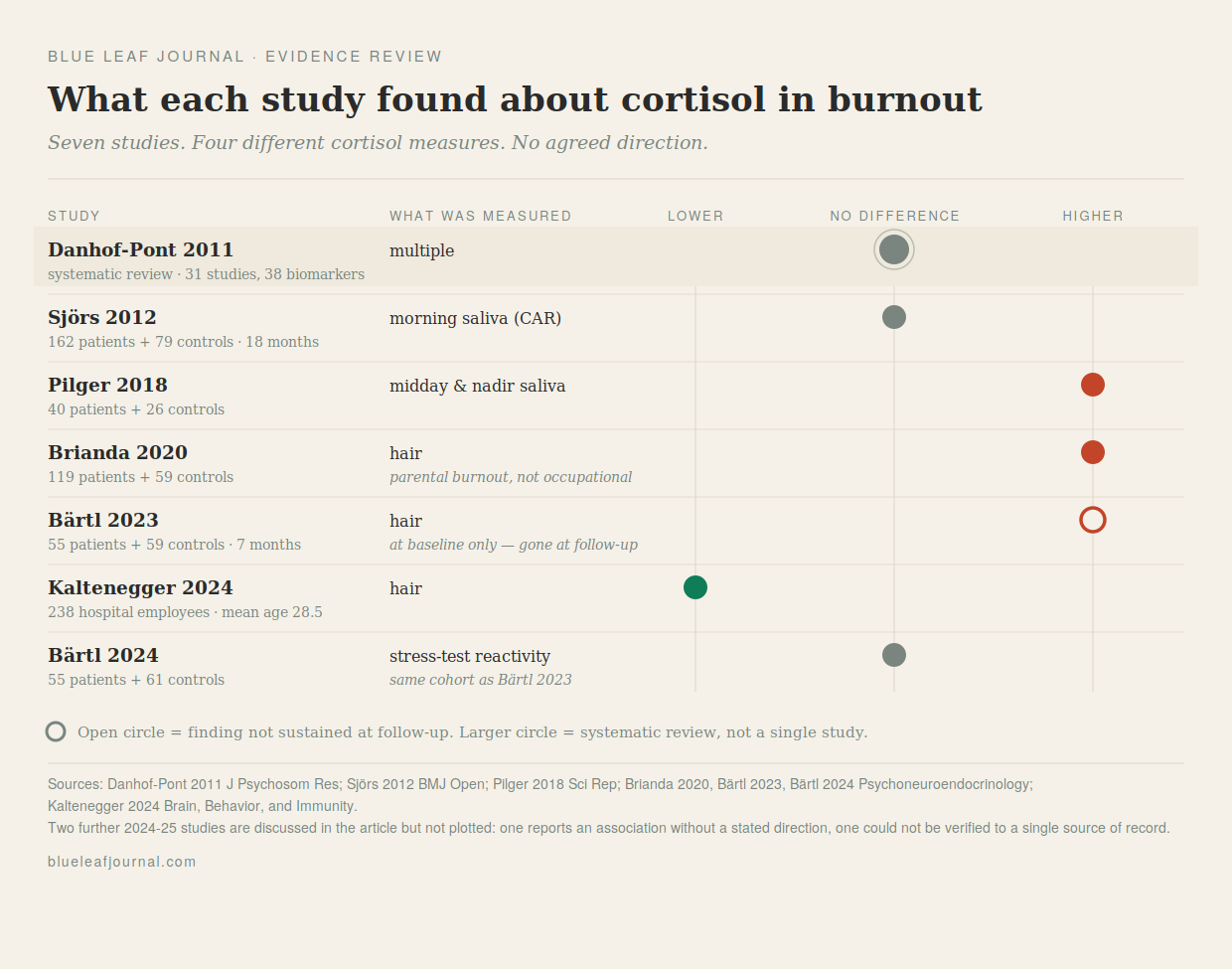
The short answer: salivary cortisol testing is a real, validated clinical test — for two rare endocrine diseases, one of which affects roughly 40 to 70 people per million.7 For burnout, the evidence base does not support a diagnostic claim. A 2011 systematic review examined 31 studies covering 38 candidate biomarkers and concluded that no biomarker for burnout was found.1 The fifteen years since have added studies pointing in three different directions.
The thing producing that mismatch is worth naming, because it will be waiting on the next kit as well: the validation gap — the distance between what a test has been validated to detect and what it is being sold to reveal. It requires no dishonesty from anybody. The assay works. It was simply validated against a different question from the one in the envelope.
The short version, with numbers
- 31 studies, 38 biomarkers, none confirmed. The only systematic review of biomarkers in burnout concluded that no potential biomarker was found, "largely due to the incomparability of studies."1
- Seven studies, three different directions. Across the research reviewed here, cortisol in burnout has been reported as lower, higher, and no different from controls — sometimes within the same research group.2,3,4,5,6
- The largest and longest study found nothing. 162 patients and 79 controls followed for 18 months: the morning cortisol response was no different from controls and did not change across treatment.2
- The test is validated for Cushing’s syndrome. Mayo Clinic Laboratories lists two uses for its salivary cortisol assay: screening for and diagnosing Cushing’s syndrome. It states the assay cannot diagnose adrenal insufficiency.8
- Burnout has no diagnostic criteria to validate a test against. The WHO classifies burn-out as an occupational phenomenon and states plainly: "It is not classified as a medical condition."9
The methods authority for this review
Prof. Dr. Tobias Stalder
Professor of Clinical Psychology, University of Siegen. He led the fourteen-author expert consensus guidelines on how the cortisol awakening response must be assessed — the document that establishes why unsupervised sampling is a threat to validity — and was lead author of the 2025 review of the cortisol awakening response in Endocrine Reviews. His long-standing collaborator Prof. Dr. Clemens Kirschbaum (TU Dresden faculty · Google Scholar · ResearchGate) of TU Dresden developed much of the salivary cortisol methodology this field runs on.
What we read: Stalder et al., Psychoneuroendocrinology (2016), the expert consensus guidelines;14 Stalder et al., Endocrine Reviews (2025).10 Both are linked in full at the end of this review, alongside the seven primary studies assessed.
Where to follow this work: University of Siegen faculty profile · Publication list · Endocrine Reviews, 2025
In this review: Scope and method · Key terms · What the test is validated for · The evidence table · Why the studies disagree · How strong is this evidence · The one move · FAQ
Informational, not medical advice. Persistent fatigue with new physical symptoms warrants a clinician, not a home test kit.
This is Volume 3 of a three-part series. Volume 1 covers what a standard blood panel does and does not measure, and why "normal" is not the same as "nothing found." Volume 2 covers how to tell exhaustion that has a medical cause from exhaustion that has a life cause. This volume examines the test most often proposed as the tiebreaker.
Scope and Method
This review covers cortisol measurement as a proposed marker of burnout in working-age adults: salivary cortisol across the day, the cortisol awakening response, hair cortisol concentration, and cortisol reactivity to a laboratory stress test.
Studies were located through Europe PMC by title search for burnout and cortisol, supplemented by the field’s one systematic review. Included were controlled studies reporting a cortisol measure in a defined burnout group against a comparison group, plus longitudinal studies within a burnout cohort. Every figure in this review is drawn from the source cited beside it.
What this review does not cover. It does not assess whether cortisol matters in stress physiology generally — it plainly does. It does not address cortisol testing in pregnancy, in people taking corticosteroids or oestrogen preparations, or in shift workers, all of which alter cortisol independently.8 It does not evaluate any commercial test brand. And it does not attempt to say what is causing your fatigue, which is a question about you rather than about a literature.
Two exclusions worth stating. A 2024 study of hair cortisol in healthcare professionals was retracted by its journal in 2025 and is excluded. A second 2024 study of cortisol reactivity in physician burnout was excluded because two bibliographic databases record it under different journals, and a citation that cannot be resolved to one source of record does not belong in an evidence table.
Key Terms
Cortisol awakening response (CAR) — the sharp rise in cortisol across the first 30 to 45 minutes after you wake in the morning. It is part of the normal daily rhythm, and it is a response to having woken, not a cause of waking.10
Diurnal slope — the shape of the whole day’s cortisol curve, high in the morning and falling towards a low point (the "nadir") late in the day. Some research finds the slope more informative than the morning spike.3
Hair cortisol concentration (HCC) — cortisol measured from a lock of hair, giving an average over roughly the preceding months rather than a snapshot. Attractive in theory because it sidesteps the timing problem; in practice it has produced some of the most contradictory findings in this literature.4,5,6
HPA axis — the hypothalamic-pituitary-adrenal axis, the feedback loop between brain and adrenal glands that governs cortisol release. The system a cortisol test is trying to read.
Burn-out (ICD-11 QD85) — classified by the WHO as an occupational phenomenon, defined by exhaustion, mental distance from one’s job, and reduced professional efficacy. Explicitly not classified as a medical condition.9
What a Cortisol Test Is Actually Validated For
This is the part most reviews skip, and it settles more than the study-by-study argument does.
Late-night salivary cortisol is a genuine diagnostic test with a genuine job. Mayo Clinic Laboratories lists its salivary cortisol assay as useful for exactly two things: "Screening for Cushing syndrome" and "Diagnosis of Cushing syndrome in patients presenting with symptoms or signs suggestive of the disease."8 The Endocrine Society’s clinical practice guideline names it as one of the accepted first-line tests for that diagnosis.11 The US National Institute of Diabetes and Digestive and Kidney Diseases lists it alongside the 24-hour urinary free-cortisol test and the low-dose dexamethasone suppression test, and notes that doctors typically run two of the three before confirming.7
Cushing’s syndrome is rare. The NIDDK puts it at roughly 40 to 70 people out of every million.7 That is somewhere in the region of one person in twenty thousand.
The same Mayo listing also states what the assay cannot do: "Midnight salivary cortisol assay cannot diagnose hypocortisolism or Addison disease because of the limited sensitivity of the assay method."8 So the test cannot even be run in reverse to rule out the low-cortisol condition that "adrenal fatigue" marketing gestures at. It is a screening tool for one direction of one rare disease.
Nothing in that validated use is a claim about tiredness in a person whose life has been too heavy for four years.
The Evidence Table
| Study | Sample | What was measured | Finding | Limitation |
|---|---|---|---|---|
| Danhof-Pont, van Veen & Zitman, 20111 | Systematic review: 31 studies, 38 biomarkers | Hormonal, immune and cardiovascular markers | None confirmed. "No potential biomarkers for burnout were found" | Authors attribute the null result largely to incomparability between studies, not to proof of absence |
| Sjörs, Ljung & Jonsdottir, 20122 | 162 patients, 79 controls, 18 months | Cortisol awakening response | No difference. CAR matched controls and did not change during treatment | Two samples per day where three or more are recommended; sample skewed to higher socioeconomic status |
| Pilger et al., 20183 | 40 patients, 26 controls (median age 49) | Midday and nadir salivary cortisol | Higher. Both elevated; fell ~30% and ~25% after treatment | Small sample relative to covariates; sample timing not monitored by study staff |
| Brianda et al., 20204 | 119 cases, 59 controls | Hair cortisol | Higher. HCC 213% higher than controls | Parental burnout, a different construct from occupational burnout |
| Bärtl et al., 20235 | 55 patients, 59 controls, ~7 months | Hair cortisol | Higher, then not. Related to burnout at baseline but not at follow-up | The finding did not survive its own follow-up; same cohort as the 2024 paper below |
| Kaltenegger et al., 20246 | 238 hospital employees, mean age 28.5 | Hair cortisol | Lower. Work stress negatively associated with HCC (β = −0.16, p = .003) | Young sample; a workplace-stress exposure rather than a burnout diagnosis |
| Bärtl et al., 202412 | 55 patients, 61 controls | Cortisol reactivity to a lab stress test | No difference between burnout and control groups | Same Regensburg cohort as the 2023 paper — not an independent replication |
| Gajewski et al., 202513 | 196 working adults, aged 20–65 | Hair cortisol | Association present, but moderated by age and by psychosocial and immunological markers | The abstract reports an association without a clean direction; not plotted in the figure below for that reason |
Read the finding column downward. None, none, higher, higher, higher-then-not, lower, none, conditional. That is not a literature converging on an answer.
Why the Studies Disagree
Three reasons, and they compound.
1. There is no diagnostic target to validate against. A test is validated by comparing it to a definition of the disease. Burn-out has no such definition in the clinical sense. The WHO added it to ICD-11 as an occupational phenomenon and stated: "It is not classified as a medical condition."9 It is defined by three experiential dimensions — energy depletion, mental distance from the job, reduced professional efficacy — and applies specifically to the occupational context. Different research groups therefore recruit different people under the same word. Danhof-Pont’s review reached exactly this conclusion: the failure was "largely due to the incomparability of studies."1
2. They are not measuring the same thing. Look at the third column of the table. Morning saliva, midday and nadir saliva, hair, and stress-test reactivity are four different physiological quantities over four different timescales. Pilger’s group found the midday and nadir readings outperformed the awakening response in the same participants3 — which means a study measuring only CAR and a study measuring only the nadir could disagree while both being correct.
3. The measurement itself is fragile. This is the finding with the most direct bearing on a kit you use at home. A fourteen-author expert consensus in Psychoneuroendocrinology set out how the cortisol awakening response must be assessed, and stated that the method "lacks direct researcher oversight which can be problematic as the validity of CAR measurement critically relies on participants closely following a timed sampling schedule, beginning with the moment of awakening."14 The guidelines devote a section to objective verification of sampling accuracy.
Read that again with a padded envelope in mind. Under research conditions, with trained staff and electronic monitoring, timing drift is treated as a threat to validity serious enough to need its own consensus document. Pilger’s team named it as a limitation of their own study, because collections "were not monitored by study personnel."3 A home kit has no monitoring at all. You wake, you find the tube, you locate your glasses, the dog needs letting out. Fifteen minutes have gone. The number you post back is a real number. It is not necessarily a number about you.
The test is real. The target isn’t.
How Strong Is This Evidence?
Confidence grade
Contested
What this grade means: the literature disagrees with itself, and the disagreement is not the kind that more studies of the same design will resolve.
What is well established: cortisol is a real hormone with a real daily rhythm, chronic stress genuinely affects that rhythm, and salivary cortisol is a validated test for Cushing’s syndrome.8,11 None of that is in dispute.
What is not established: that any cortisol measurement can identify burnout, quantify it, or distinguish it from ordinary heavy tiredness. One systematic review of 31 studies found no biomarker at all.1 The largest and longest single study found no difference across 18 months.2
The limitation that matters most for the reader of this page: almost none of this research was conducted on women in their late forties, fifties and early sixties. The Regensburg cohorts are working adults; Kaltenegger’s sample had a mean age of 28.5; Brianda’s studied parents of young children. Pilger’s median age of 49 is the closest fit in the table, from a study of 40 patients. Even if a cortisol marker for burnout existed, it would not yet have been validated in the group most likely to be searching for one.
When this belongs with a doctor
Cortisol testing has a real clinical use, and this is it. See a clinician rather than a test provider if fatigue comes with any of the following.
Suggesting high cortisol: weight gain with noticeably thin arms and legs, a rounding face, a fatty pad between the shoulders, wide purple stretch marks, easy bruising, muscle weakness, new facial or body hair, or menstrual periods that stop without another explanation.7
Suggesting low cortisol: fatigue with muscle weakness, loss of appetite, unexplained weight loss and abdominal pain.7,15
These lists are a reason to book an appointment, not a checklist to score yourself against. Both conditions are uncommon, both are diagnosed with a specific sequence of tests, and both need a clinician to order and interpret them. Fatigue that is severe, sudden, or accompanied by any new physical sign belongs in a consulting room regardless of what this review concludes.
What to Say at the Appointment
The three questions in the next section are for a test provider. This is the other conversation, and it is the one the evidence above actually points towards.
The obstacle a woman meets after two years of unexplained exhaustion is rarely a shortage of available tests. It is that fatigue without a physical sign reads, inside a ten-minute appointment, as a life problem rather than a medical question — and the reply tends to arrive before the account is finished. Two sentences change what the appointment is about.
Short enough to read off a phone screen
To open: “I have two weeks of notes on when the exhaustion is worst and what came before it. I would like to work through what has already been excluded and what has not.”
If the answer is that the bloods were normal: “Which panel was that, and did it include ferritin, B12, thyroid function and vitamin D? I would like to know what was measured, rather than that nothing was found.”
Neither line requests a treatment and neither disputes a clinical judgement. The second is simply the difference between normal and not looked for, which Volume 1 of this series sets out in full. A saliva kit cannot supply that distinction. A list of what was actually on the panel can, and it costs nothing.
The One Move
Not a verdict on the kit in front of you. A method you can use on the next one too.
Before paying for any biomarker test, ask three questions in this order.
- What condition is this test validated to detect? Not what it is marketed to reveal — what it is validated for. That answer is usually findable in a laboratory’s own test catalogue in under two minutes, and it is often much narrower than the sales page.
- What would I do differently depending on the result? If a high number and a low number lead to the same next step, the test is not a decision aid. It is reassurance, priced.
- Who interprets it, and against what reference range? A result with no clinician attached is a number without a context. Reference ranges vary by assay, by collection time, and by whether you take oestrogen — which the Mayo listing names explicitly as a source of diagnostic confusion.8
Applied to a home cortisol test for burnout, those three questions answer themselves in about four minutes, which is roughly £90 saved and, more usefully, a fortnight of waiting not spent.
The thing worth measuring instead is duller and more useful: two weeks of what the days actually contain. When the tiredness is worst, what preceded it, what you were doing, and how much of the week was yours. That record is what makes the next appointment productive, because it is the information a clinician cannot get from a panel and cannot get from you in ten minutes without it.
If the honest answer is that the load has been too heavy for too long and no test was ever going to show that, the Quiet Audit is ten private minutes on exactly that question. No programme, no advice, nobody sees your answers. Start here.
Frequently Asked Questions
Can a cortisol test diagnose burnout?
No. Burnout is classified by the WHO as an occupational phenomenon and explicitly not as a medical condition, so there is no clinical definition for a test to be validated against.9 The one systematic review of biomarkers in burnout examined 31 studies and 38 candidate markers and found none.1
Is salivary cortisol testing a real medical test?
Yes. Mayo Clinic Laboratories lists late-night salivary cortisol as useful for screening for and diagnosing Cushing’s syndrome, a condition affecting roughly 40 to 70 people per million.7,8 The same listing states the assay cannot diagnose adrenal insufficiency or Addison’s disease.8
Why do home cortisol kits give such variable results?
Because cortisol changes by the minute after waking, and the validity of the measurement depends on hitting the sampling schedule precisely. Expert consensus guidelines state that validity "critically relies on participants closely following a timed sampling schedule, beginning with the moment of awakening" — a condition research studies struggle to meet even with staff supervision.14
Is "adrenal fatigue" the same as low cortisol?
No. Adrenal insufficiency is a diagnosable endocrine disease with defined symptoms and blood-test criteria.15 The separate popular concept of "adrenal fatigue" is not a recognised diagnosis, and the salivary assay most often sold to investigate it is not sensitive enough to detect low cortisol states in the first place.8
Does this mean stress has no physical effect?
The opposite. Chronic stress has well-documented physiological effects, and cortisol is genuinely involved in them.10 What is not established is that a single measurement of cortisol can quantify how depleted a particular person is. The physiology is real; the measurement is the weak link.
My doctor says my bloods are normal. What should I ask for next?
A conversation about what a standard panel does and does not cover is usually more productive than another test. Volume 1 of this series sets out what is typically included, what is not, and the specific things worth asking to have checked.
The rest of this series
Related reading: what the cortisol videos get wrong about night waking, the midlife energy drains that are not laziness, and how perimenopause and depression differ in pattern rather than in feeling.
If You Want the Next Quiet Step
The question underneath the kit is rarely about hormones. It is whether the exhaustion is legitimate without a laboratory confirming it. It is. The Quiet Audit is a short, private set of questions about what is actually being carried. Start here.
The envelope can go back unopened. Most of them can.
References
1. Danhof-Pont MB, van Veen T, Zitman FG. Biomarkers in burnout: a systematic review. Journal of Psychosomatic Research. 2011;70(6):505–524. doi.org/10.1016/j.jpsychores.2010.10.012
2. Sjörs A, Ljung T, Jonsdottir IH. Long-term follow-up of cortisol awakening response in patients treated for stress-related exhaustion. BMJ Open. 2012. pmc.ncbi.nlm.nih.gov/articles/PMC3400075
3. Pilger A, Haslacher H, Meyer BM, et al. Midday and nadir salivary cortisol appear superior to cortisol awakening response in burnout assessment and monitoring. Scientific Reports. 2018;8. nature.com/articles/s41598-018-27386-1
4. Brianda ME, Roskam I, Mikolajczak M, et al. Hair cortisol concentration as a biomarker of parental burnout. Psychoneuroendocrinology. 2020. sciencedirect.com
5. Bärtl C, et al. Investigation of cross-sectional and longitudinal associations between work-related burnout and hair cortisol: The Regensburg Burnout Project. Psychoneuroendocrinology. 2023. sciencedirect.com
6. Kaltenegger HC, et al. Prospective associations of technostress at work, burnout symptoms, hair cortisol, and chronic low-grade inflammation. Brain, Behavior, and Immunity. 2024. europepmc.org
7. National Institute of Diabetes and Digestive and Kidney Diseases. Cushing’s Syndrome. niddk.nih.gov
8. Mayo Clinic Laboratories. SALCT — Cortisol, Saliva: test catalog overview. mayocliniclabs.com/test-catalog/overview/84225
9. World Health Organization. Burn-out an "occupational phenomenon": International Classification of Diseases. 28 May 2019. who.int
10. Stalder T, Oster H, Abelson JL, et al. The Cortisol Awakening Response: Regulation and Functional Significance. Endocrine Reviews. 2025;46(1):43–59. academic.oup.com
11. Nieman LK, Biller BMK, Findling JW, et al. The diagnosis of Cushing’s syndrome: an Endocrine Society Clinical Practice Guideline. Journal of Clinical Endocrinology & Metabolism. 2008;93(5):1526–1540. academic.oup.com
12. Bärtl C, et al. Neural and cortisol responses to acute psychosocial stress in work-related burnout: The Regensburg Burnout Project. Psychoneuroendocrinology. 2024. europepmc.org
13. Gajewski PD, et al. The association between hair cortisol and burnout is moderated by age, psychosocial, and immunological markers. Brain, Behavior, & Immunity — Health. 2025. europepmc.org
14. Stalder T, Kirschbaum C, Kudielka BM, et al. Assessment of the cortisol awakening response: Expert consensus guidelines. Psychoneuroendocrinology. 2016;63:414–432. doi.org/10.1016/j.psyneuen.2015.10.010
15. National Institute of Diabetes and Digestive and Kidney Diseases. Adrenal Insufficiency & Addison’s Disease. niddk.nih.gov
About the researcher
Prof. Dr. Tobias Stalder holds the chair in Clinical Psychology at the University of Siegen. His doctorate is in psychology — he is a research scientist, not a physician, and nothing in this review is medical advice. His research concerns the measurement of cortisol in hair and saliva as an index of long-term stress exposure, and the methodological conditions under which those measurements can be trusted. Faculty profile: uni-siegen.de. Publication list: ResearchGate.
Blue Leaf Journal is not affiliated with Prof. Stalder, Prof. Kirschbaum, the University of Siegen, TU Dresden, Mayo Clinic Laboratories, the Endocrine Society, the NIDDK or the World Health Organization. None of them has reviewed, approved or endorsed this review, and none is responsible for it. Nobody named here paid for or was paid for this coverage. Every figure is drawn from the sources linked in the references and can be checked there. Sources were checked on 26 August 2026; corrections to norawhitfield@blueleafjournal.com.
Miriam Alderton is Research Editor at Blue Leaf Journal. She reads the methods section first and the abstract last, and every figure in this review is linked to its source above. Published: August 27, 2026.