The Scratching You Only Notice When Someone Points It Out
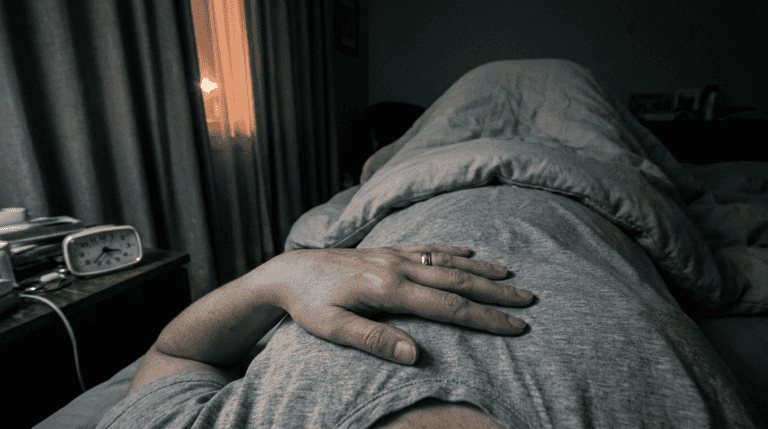
Your husband said it first, and not as a complaint. “You’ve been scratching your arm for about ten minutes.”
You had not noticed. You look down and there are four pale lines above your wrist where you have been going at the same patch, absently, through most of a television programme. It is not a rash. There is nothing to see. It is worst at night, worst after a hot shower, and worst on your shins, forearms, and back, which is inconvenient because you cannot reach the back.
Itchy skin in menopause gets treated as a laundry detergent question. It is usually a tissue question.
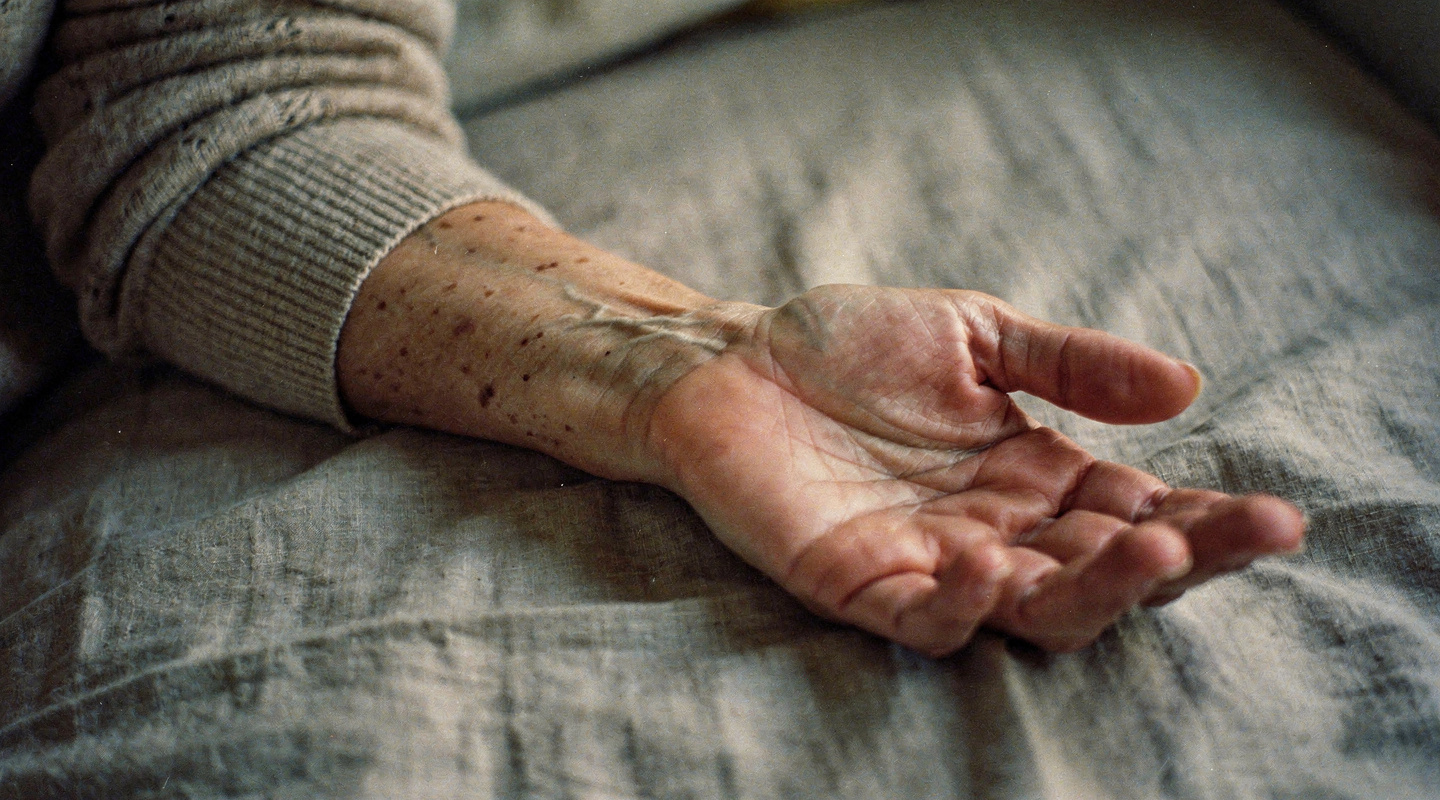
The short answer: estrogen receptors sit throughout the epidermis and dermis, and estrogen loss reduces dermal collagen, skin thickness, and the barrier’s ability to hold water. Up to 30% of dermal collagen can be lost in the first five years after menopause, with roughly 2% a year after that, and skin thickness falls about 1.1% a year.¹
The skim version
- Skin is estrogen-responsive tissue. Receptors are present in both the epidermis and the dermis.¹
- Up to 30% of dermal collagen can go in the first five years after menopause, then around 2% a year.¹
- Skin thickness declines roughly 1.1% per year in the same period.¹
- Brincat’s work found this deterioration tracks estrogen loss more closely than chronological age.¹
- A thinner barrier loses water faster, and dehydrated skin itches. That is the whole mechanism.
What is actually happening to the skin · Why it is worse at night · The crawling sensation · The four-minute change · Questions
Why do I get itchy skin in menopause when my skin was always fine?
Because the structure holding water in your skin has thinned, and thin skin dehydrates faster than thick skin does.
Estrogen receptors are distributed through the epidermis and the dermis, so falling estrogen reaches several things at once: collagen production, the lipids that seal the barrier, and the skin’s ability to retain moisture.¹ The number that surprises most women is the pace. Up to 30% of dermal collagen can be lost in the first five years after menopause. After that it settles to roughly 2% a year.¹
Read that again, because it reframes a lot. The steepest part of the change is front-loaded into about sixty months. If your skin seemed to alter faster than you could account for somewhere around fifty-one, you were not imagining a step change.
The finding that makes this hormonal rather than simply chronological came from Brincat and colleagues in 1987, whose work showed the deterioration correlates more convincingly with estrogen deficiency than with age itself.¹ Two women of identical age with different estrogen histories do not have the same skin.
What that means practically is that the itch is a barrier failure, not a hygiene failure. A barrier that leaks water leaves the nerve endings in dry skin easier to irritate, and irritated nerve endings register as itch.
Why is it always worse at night?
Three ordinary things converge after nine, and none of them are mysterious.
Skin loses water faster in the evening as body temperature rises slightly and then falls, and a barrier already short on lipids leaks more during that shift. The bed is warm, and warmth lowers the threshold at which skin registers itch. And after nine there is nothing else competing for your attention, so a low-grade signal that was easy to ignore during a meeting has the floor.
The hot shower is the one worth naming separately, because it is usually the single biggest own goal.
Hot water strips the lipid layer. It feels wonderful and it removes precisely the thing that was holding your water in, which is why the itch that arrives twenty minutes after a hot bath is not a coincidence. You are not reacting to the water. You have just washed off the barrier.
| Points toward the menopausal pattern | Worth getting looked at | |
|---|---|---|
| What you see | Nothing, or faint scratch lines you made | A visible rash, welts, or scaling patches |
| Where | Shins, forearms, back, fairly symmetrical | One defined area, or spreading edges |
| Timing | Worse at night and after hot water | Constant, or waking you repeatedly |
| Other signs | Skin generally drier, thinner, slower to mend | Weight loss, fever, jaundice, night sweats that are new |
| Response to moisturiser | Genuine partial improvement | No change after several weeks of proper use |
The right-hand column matters. Persistent itch with no visible cause can occasionally signal thyroid, liver, kidney, or blood conditions, so a symptom that does not respond to barrier care deserves blood tests rather than another cream.
If this is another symptom quietly filed as not worth mentioning, the Quiet Audit is ten minutes on the file. Start here.
What about the crawling sensation?
Some women describe something different from itch: a sensation of insects moving on or under the skin, usually on the arms or scalp, often at night. The medical term is formication.
Being straight with you about the evidence here, because it matters. This sensation is widely reported by women in the transition and appears in menopause symptom lists, but the research base behind it is much thinner than the collagen findings above. I am not going to dress up a well-known anecdote as a study.
What is worth knowing is that it is a recognised description, you are not the first person to say it out loud, and it is worth mentioning to a clinician rather than filing under things too strange to raise. Persistent crawling sensations can also have other causes, including some medications and nutritional deficiencies, which is a reason to describe it plainly rather than assume it is hormonal and leave it there.
Formication is the sensation of insects crawling on or beneath the skin with nothing present to cause it.
Why the moisturiser aisle is so confusing
Standing in front of forty tubes with no way to tell them apart is a common experience, and the labels are not designed to help. There are really only three jobs a product can do, and knowing which is which cuts the aisle down to about four options.
Humectants pull water into the top layer of skin. Glycerin, hyaluronic acid, urea. They are useful and they are also the reason some products feel wonderful for an hour and then leave skin tighter, because in dry air a humectant with nothing sealing it can draw water out of deeper skin and lose it to the room.
Occlusives sit on top and physically block water leaving. Petrolatum, dimethicone, mineral oil. Unglamorous, cheap, and the most effective single category for a barrier that leaks.
Emollients fill the gaps between skin cells and are what makes skin feel smooth rather than rough. Ceramides, squalane, fatty acids.
Most decent creams contain all three, which is why the sensible move is to stop reading the front of the tube and check that the ingredient list has something from each group near the top. A plain ointment with petrolatum in it will usually outperform a beautifully packaged serum for this particular symptom, which is annoying but true.
One more thing to skip: anything sold as “cooling” that lists menthol or camphor. It interrupts the itch signal briefly and irritates the barrier you are trying to repair.
The four-minute change that does most of the work
Almost every woman with this has bought a better moisturiser. Fewer have changed when they apply it, and the timing matters more than the product.
Here is the change: pat dry, then moisturise within three minutes, while your skin is still damp from the shower.
That is it. Same cream, different window.
The reason is mechanical. Damp skin has water sitting in the top layer, and an emollient applied then traps it. The same cream on dry skin an hour later has much less to seal in. You are not adding moisture with a moisturiser so much as preventing the loss of what is already there.
Two supporting changes cost nothing. Turn the water down from hot to warm, which will feel disappointing for about four days and then stop registering. And choose an unscented emollient, because fragrance is a common irritant on a barrier that is already compromised.
Give it three weeks before you judge it. Barrier repair is slow, and the usual mistake is abandoning it at day five.
If you have noticed this alongside other changes that arrived without announcement, they are not separate stories. The same shift shows up in eyes that burn by four in the afternoon, in a part in your hair that has widened, and in a shoulder that stopped reaching behind you. Different tissue, one underlying change.
Questions women actually ask about this
Will HRT fix my skin?
Systemic hormone therapy is not prescribed for skin alone, and it would be dishonest to sell it as a skin treatment. Some women on hormone therapy for other symptoms notice their skin improves. That is a reasonable thing to raise in a conversation about whether hormone therapy suits you overall, which is worth having on the full picture of what HRT treats rather than on this symptom alone.
Do collagen supplements help?
The evidence is mixed and the marketing is far ahead of it. If you want to spend money on this, barrier care has the better evidence behind it and costs less.
Is topical estrogen a thing for skin?
It is an area of genuine research interest rather than routine practice, and it is not something to source yourself. Raise it with a clinician if you are curious about where the evidence currently sits.
How long does this phase last?
The steep collagen loss is concentrated in roughly the first five years, then slows to about 2% a year.¹ So the rate of change eases. The underlying dryness tends to be managed rather than outgrown.
Should I stop shaving my legs?
No, but shave at the end of the shower rather than the start, use something with slip rather than soap, and moisturise straight afterwards. Dragging a blade over an already thin barrier is a reliable way to make the shins worse.
Informational, not medical advice. Persistent itch with no visible rash, or itch with weight loss, fever, or jaundice, needs your own clinician, who can examine you and run bloods.
If the noticing is the part that keeps getting postponed
Somebody else spotted the scratching before you did. That is worth sitting with for a second, because it is rarely only about skin. The signals from your own body tend to be the last items on a list that has everyone else’s needs above them.
Skin is not the only tissue quietly rewritten by falling estrogen. The brain runs on it too, which is why a lost word can arrive in the same year as the itch. What the scans actually found, and why it is not the decline it feels like.
The Quiet Audit is ten minutes of questions about how you came to be last on your own list. No advice, no programme. Just the document. Start here.
References
- Estrogen-deficient skin: The role of topical therapy. International Journal of Women’s Dermatology. (Includes the Brincat et al. 1987 findings on estrogen deficiency versus chronological aging — ResearchGate.)
- Beyond Hot Flashes: Understanding and Treating Menopause-Associated Skin Changes. Journal of Integrative Dermatology.
Written by Nora Whitfield for Blue Leaf Journal. Updated: August 5, 2026.