Your Heart Thuds in the Dark and You Lie Very Still
Body · The Reading Room, Vol. 59 · 9 min read · half of women get them, and the red flags that mean it’s not just perimenopause
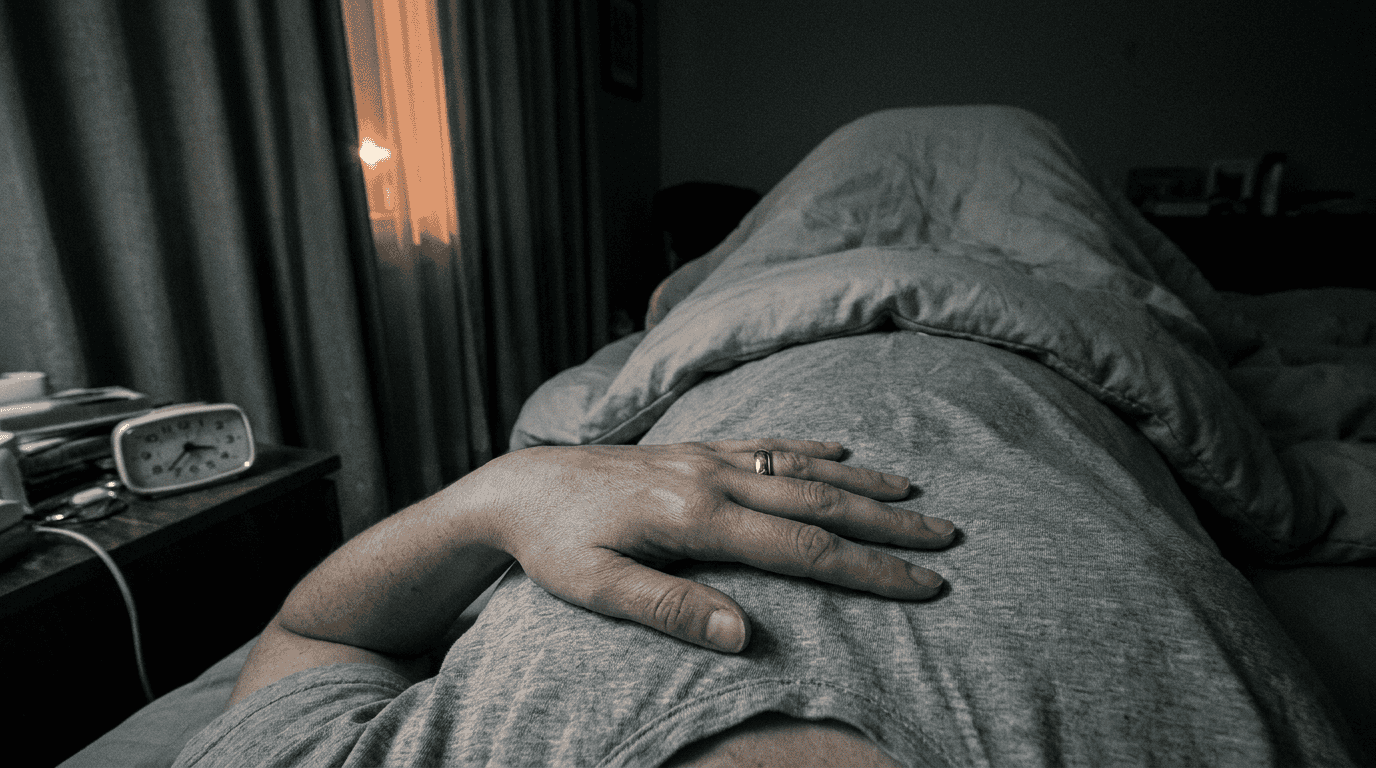
You are awake before you know why. Then you feel it: a thud, a pause that goes on slightly too long, then a run of beats too quick to count. You do not move. You lie there with one hand flat on your ribs doing the arithmetic every woman does at that hour, which is whether this is the night you should wake someone.
Quick answer: heart palpitations in perimenopause are extremely common — about half of women get them, according to the largest long-term study of the menopause transition, and researchers found no link to underlying heart disease.1 What that means for you, and the signs that mean it’s worth getting checked today, is below.
Then it stops. By morning it seems ridiculous. You do not mention it to anyone, and you do not book anything, and three weeks later it happens again.
Heart palpitations in perimenopause are one of the most common symptoms almost nobody warns you about, and the silence around them is the worst part of them. Hot flushes get discussed. Sleep gets discussed. A heart behaving strangely at two in the morning gets filed privately under things that are probably nothing, which is exactly the category that keeps a person awake.
The short answer: in the largest long-term study of the menopause transition, half the women reported meaningful palpitations, and those palpitations showed no relationship to underlying heart disease when it was measured directly.¹ That is genuinely reassuring at the level of populations. It is not a substitute for having yours looked at once, properly, so you can stop wondering.
Key takeaways
- Roughly half the women followed through the menopause transition in the SWAN study reported palpitations at a meaningful level.¹
- In that study, palpitation patterns were not associated with hardening of the arteries or arterial stiffness.¹
- Women with the highest palpitation levels also had more hot flushes, more sleep trouble, higher stress and higher blood pressure, so this symptom rarely arrives alone.¹
- Population reassurance is not personal reassurance. A single proper evaluation is what buys you the right to ignore it afterwards.
- A short written log is what makes that appointment useful, because the flutter never performs on demand in a clinic.
In this article: What is actually happening · What the SWAN study found · When it needs same-day attention · The three-line flutter log · FAQ
What is actually happening when your heart does this?
A palpitation is the awareness of your own heartbeat. That is the whole definition, and it is worth sitting with, because it means the sensation can come from the heart doing something unusual or from you noticing something ordinary. Both are real. The heart does not have to misbehave for you to feel it.
What is documented is that this awareness becomes far more common across the menopause transition, and that it clusters with the other symptoms of that transition rather than standing apart from them. In the SWAN data, the women who reported the most palpitations also reported more hot flushes and night sweats, more disturbed sleep, higher perceived stress and higher blood pressure at the start of the study.¹ That is a picture of a whole system running hot, not of a heart problem hiding among other things.
The precise mechanism has not been settled, and anyone who tells you otherwise is going beyond the evidence. What is reasonable to say is that the same hormonal changes driving the flush that arrives in a meeting also affect the autonomic system that sets your heart rate, and that a body waking repeatedly through the night is a body with more adrenaline in it at three in the morning than at three in the afternoon. That is why so many women only notice this in bed. It is quiet, you are still, and there is nothing else competing for your attention.
Definition: palpitations are the conscious awareness of your heartbeat, whether described as thudding, fluttering, skipping, or racing. The word describes a sensation, not a diagnosis, and it does not by itself indicate anything about the health of the heart.
What did the SWAN study actually find about heart palpitations in perimenopause?
SWAN, the Study of Women’s Health Across the Nation, has followed a large, multi-ethnic group of women through the menopause transition for decades. In 2023 a team led by Janet Carpenter published an analysis of palpitations across that transition using data from 3,276 women.¹
Three patterns came out of it. Just under sixteen per cent of women had a high probability of palpitations from perimenopause into early postmenopause, easing off later. Another thirty-four per cent had a moderate probability over the same window, easing off in the same way. The remaining half had a sustained low probability throughout.¹
Add the first two together and you get roughly one in two. That is the number worth carrying away, because the loneliness of this symptom comes almost entirely from assuming you are the exception.
The second finding is the one that matters more. In a subset of 1,559 women, the researchers measured actual markers of cardiovascular disease, carotid artery thickening and arterial stiffness, and tested whether the palpitation patterns predicted them. They did not.¹ Women in the high-palpitation group were no more likely to show these early signs of heart disease than women who barely noticed their hearts at all.
A separate systematic review by the same group had already found how wide the reported range is across studies, from around twenty to forty per cent during perimenopause depending on how the question is asked.² And a further analysis found that the distress women report about palpitations does not track neatly with how often they happen.³ Some women get them constantly and shrug. Others get them rarely and lie awake. Both responses are ordinary.
If you have been quietly managing a symptom for months without telling anyone, that pattern is usually bigger than the symptom. Start here.
When does this need same-day attention?
Everything above is about populations. You are not a population, and the honest version of this article has to say so clearly. Some palpitations do signal something that needs treating, and the features that change the urgency are well established.
| Book it, and get on with your week | Get seen the same day |
|---|---|
| Brief flutters or thuds, then normal | Palpitations with chest pain or pressure |
| Happens mostly at night or when resting | Fainting, or nearly fainting, with them |
| Settles on its own within seconds or minutes | Severe breathlessness alongside them |
| No family history of early heart disease | A fast, sustained beat that will not settle |
The column on the right is not a reason to panic about the column on the left. It exists so the left-hand column can be genuinely reassuring rather than vaguely reassuring, which is a different thing and much less use at two in the morning.
Even for the left-hand column, get it looked at once. Ask specifically what your options are for recording an episode as it happens, because that is the whole difficulty with this symptom. It never performs in a clinic. A one-off tracing taken on a Tuesday afternoon when your heart is behaving perfectly tells you almost nothing, and going home with that is how women end up back at three in the morning with the same question and no better answer.
Then, once you have it, you get to stop. That is the actual prize. Not the reassurance itself, but permission to stop running the check.
The three-line flutter log
Keep a note on your phone. When it happens, write three things and nothing more.
- Time and day. Just the number. 02:40, Tuesday.
- What was happening in the ten minutes before. Lying still. Stood up from the sofa. Second glass of wine. Woke from a dream. Third hot flush of the night.
- How long, and how it ended. Maybe twenty seconds, stopped on its own. Or, several minutes, still there when I got up for water.
Three lines. Ten seconds to write. Do it for a fortnight before your appointment and you will walk in with the one thing that is genuinely hard for a clinician to get, which is a pattern across time rather than a description from memory.
The log tends to do something else too. Most women who keep one for two weeks discover their episodes cluster somewhere obvious, after alcohol, on the nights with the worst flushes, in the week before a period while there still is one, on days that ended with a difficult conversation. Seeing that written down changes the symptom from something arriving out of nowhere into something with a shape. A body that has been waking you at three most nights is running on a different chemistry than a rested one, and the log is what makes that connection visible instead of theoretical.
Do not use the log to reassure yourself out of the appointment. That is the failure mode for capable women, who are very good at building a system that makes a problem manageable and then never taking the problem anywhere. The log is preparation, not a substitute.
Common questions about heart palpitations in perimenopause
Is this just anxiety?
Sometimes anxiety causes them, sometimes they cause anxiety, and often the two are running at once. The SWAN data showed palpitations clustering with higher stress and depressive symptoms, without establishing which came first.¹ The practical point is that being anxious about your heart does not mean the sensation was imaginary.
Why is it always at night?
Partly because you are still and undistracted, so there is nothing competing with the sensation. Partly because disrupted sleep and night sweats put more adrenaline into the small hours. Both make an ordinary heartbeat easier to notice and an unusual one harder to ignore.
Does HRT help with this?
It is a reasonable question to bring to your clinician rather than one to settle from an article, particularly since palpitations track so closely with hot flushes and sleep. Our no-hype explainer on what HRT does and does not do is a fair place to work out what to ask.
Should I cut out caffeine?
Worth testing rather than assuming. Caffeine and alcohol are the two triggers most consistently reported, but the effect varies enormously between people. The log will tell you more about your own pattern in two weeks than any general advice will.
I have had these checked before and told it was nothing. Do I need to go again?
If the pattern has changed, if they are lasting longer, or if any of the same-day features have appeared, yes. A clear result from four years ago describes four years ago.
Informational, not medical advice. Anything in this article that sounds like it might be about you is a reason to talk to your clinician, not a replacement for it.
The same autonomic system behind a thudding heart at two in the morning runs on the same hormonal supply as memory and word-finding, which is why a racing pulse and a lost word can show up in the same season. What the brain part actually is, and what it is not.
If reading this was the first time you have taken the symptom seriously enough to look it up, that gap between what your body is doing and what you let yourself attend to is worth a longer look. Start here. Ten quiet minutes of questions, not a programme.
If the palpitations arrived around the same time as a new and unfamiliar anxiety, those two may share a cause: what hormones do to mood before periods change.
References
1. Carpenter, J.S., Cortés, Y.I., Tisdale, J.E., Sheng, Y., Jackson, E.A., Barinas-Mitchell, E., & Thurston, R.C. (2023). Palpitations across the menopause transition in SWAN: trajectories, characteristics, and associations with subclinical cardiovascular disease. Menopause, 30(1), 18–27. Trajectories from 3,276 women; subclinical cardiovascular disease analysis in 1,559.
2. Carpenter, J.S., Sheng, Y., Elomba, C., et al. (2021). A systematic review of palpitations prevalence by menopausal status. Current Obstetrics and Gynecology Reports, 10, 7–13.
3. Carpenter, J.S., Tisdale, J.E., Chen, C.X., et al. (2021). A Menopause Strategies-Finding Lasting Answers for Symptoms and Health (MSFLASH) investigation of self-reported menopausal palpitation distress. Journal of Women’s Health, 30(4), 533–538.
Disclosure
This article is informational and is not medical advice.
We are not clinicians or physicians. We read the published work and translate it into plain English.
Blue Leaf Journal has no affiliation with, and no endorsement from, any researcher or institution named above.
No commercial relationship exists with any person, institution, book or method mentioned here.
Every quotation and figure above was checked against the primary source on 6 September 2026. Corrections: the comment field below this article reaches the editor. We amend errors in place and note the change and its date here.
On the researcher: Janet Carpenter‘s (ResearchGate)’s SWAN analyses are peer-reviewed population research; they describe patterns across thousands of women, not a reading of your own heart.
Written by Nora Whitfield for Blue Leaf Journal. Updated: August 9, 2026.