Brain Fog at 52: The Question to Ask Before You Assume the Worst
Body · The Reading Room, Vol. 51 · 11 min read · What a 25-year federal study actually measured when it tested women’s memory during the transition, not after it
Based on the published research of
Pauline W. Maki, PhD — Professor of Psychiatry and Psychology, University of Illinois Chicago; Past President, The Menopause Society
Faculty profile, UIC Department of Psychology · SWAN Study fact sheet, memory and cognition · Google Scholar · ResearchGate
A federal study followed the same women’s test scores through the menopause transition and found something specific: it isn’t that memory gets worse, it’s that it stops improving the way it should. Here is what that distinction means and when it ends.
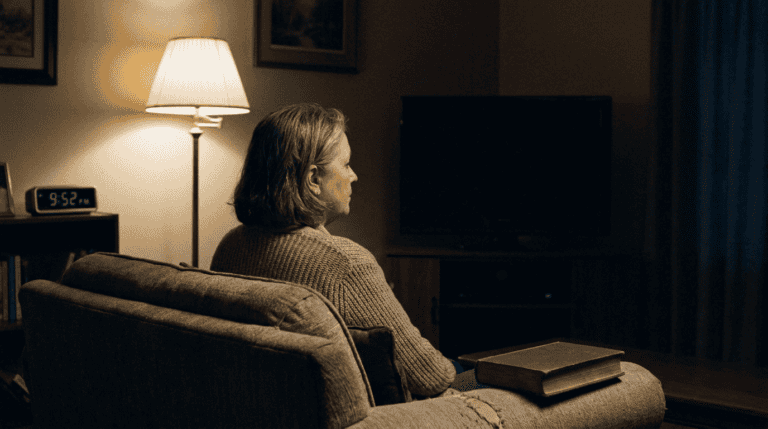
You walk into the kitchen and stand there. Whatever you came for is gone. In this morning’s meeting the word you needed — a plain one, a word you’ve used a thousand times — simply wasn’t there, and you talked around the hole and hoped no one noticed.
Then the quiet thought, the one with teeth: this is how it starts, isn’t it.
The short answer: researchers tracking the same women’s cognitive test scores across the menopause transition found a specific, measurable pattern: during perimenopause, women stop getting better at tests they’ve taken before — a normal effect called practice improvement that vanishes for one stage only, then returns once postmenopause begins.¹ That is not the signature of a disease that progresses. It is the signature of a nervous system mid-renovation. The question worth asking before you assume the worst: is this fog, or is this fear?
The skim version
- A federal study spanning 25 years and thousands of women found that perimenopause is the one stage where women’s scores don’t improve with repeated testing the way they normally would.¹
- That effect — called a practice effect — going flat isn’t decline. It’s a temporary dip in how efficiently new information gets encoded, and it reversed in early postmenopause in the same women.¹
- Roughly 60% of women report a change in memory they find unpleasant during this window. That means 40% do not — you are common, not universal.²
- A separate, independent study of 75 women found the complaints track with objective working-memory test scores, not with hormone levels alone — the fog is real, and it isn’t just a busy calendar.³
- Dementia risk and perimenopausal fog are different processes with different timelines. Dr. Maki’s framing: if menopause itself caused dementia, the rate wouldn’t be roughly one in five women — it would be closer to all of them.⁴
- A two-week, two-minute-a-day log turns a vague fear into something a doctor can actually use, and rules in or out the things that mimic this and don’t resolve on their own.
In this article: What the testing actually found · What else it could be · Why perimenopause specifically · Does it come back · When to get checked · What to say · The two-week log · Questions
What did the research actually measure, and why does it matter more than a single test score?
Most people picture a cognition study as one test, one score, one snapshot. What actually shows the transition is a repeated test, given to the same women, years apart. That distinction is the whole finding.
The Study of Women’s Health Across the Nation (SWAN), a federally funded project that has followed thousands of women through midlife since the 1990s, retested participants on verbal memory and processing speed at multiple points along the transition.¹ Under ordinary conditions, people improve slightly the second and third time they take the same kind of test — they’ve learned the format, the strategy, the rhythm of it. Researchers call this a practice effect, and its presence is actually a marker of healthy learning and memory consolidation.
In premenopause, the SWAN women showed that expected improvement. In perimenopause, it disappeared — “this improvement with practice was not seen, consistent with the women’s perception of memory and cognition difficulties,” in the study’s own language.¹ Then, in early postmenopause, the improvement came back.
Definition: a practice effect is the normal, modest improvement in test performance seen on repeat testing, driven by learning and familiarity rather than the content changing. Its disappearance during perimenopause is one of the more specific, replicated cognitive findings in menopause research — not a subjective impression, a measured one.¹

That reframes the kitchen-doorway moment. You are not failing to retain what you already knew. Your system is, for this window, less efficient at laying down new information — which is a different mechanism than forgetting old information, and a far more reversible one.
What else could this be, and how do I tell the difference?
| Perimenopausal fog | Worth ruling out separately | |
|---|---|---|
| Pattern | Comes and goes; worse with poor sleep or before a period | Steady, one-directional worsening month over month |
| What’s affected | Word-finding, working memory, focus under load | Getting lost in familiar places, forgetting how to do routine tasks |
| Who notices | You do, first and most — insight is intact | Family or coworkers notice before you do |
| Common look-alikes | — | Hypothyroidism, iron-deficiency anemia, sleep apnea, depression, certain medications |
| Response to sleep and time | Improves with better sleep; resolves by early postmenopause | Doesn’t track with sleep or hormonal stage |
Conditions that overlap with perimenopausal brain fog
- Hypothyroidism — fatigue, slowed thinking, and word-finding trouble that a TSH test catches directly, and that is common enough in this age group to test for reflexively.
- Sleep apnea — fragmented sleep degrades processing speed independent of hormones; SWAN researchers specifically found sleep fragmentation correlated with lower scores in early postmenopause.¹
- Depression or anxiety — SWAN data showed women with depressive symptoms scored worse on processing speed, and anxious women showed blunted practice-effect improvement on verbal memory — mood and cognition move together here, not separately.¹
- Iron-deficiency anemia — common in perimenopause given heavier or irregular bleeding, and fatigue plus fog is a classic presentation.
None of these are mutually exclusive with hormonal fog, and several often travel together. That is the argument for testing rather than guessing.
Why does this show up specifically in perimenopause, not before or after?
Estrogen is not only a reproductive hormone. It supports acetylcholine production in the hippocampus, the brain region most involved in forming new verbal memories, and it affects cerebral blood flow and how efficiently brain cells use glucose for energy.² During perimenopause, estrogen doesn’t decline smoothly — it swings, often unpredictably, before settling at a lower baseline in postmenopause.
Dr. Maki’s own framing of why this matters is worth reading in full: prospective studies show “a reliable change in women’s cognitive function” specifically for learning and remembering verbal material during perimenopause — and that this resolves in postmenopause, once the hormonal swinging stops and a new, stable baseline is reached.⁴
“The brain is plastic, the brain compensates, the brain adapts, and it adapts in the postmenopause.” — Pauline W. Maki, PhD
Sleep and mood are not side issues here; SWAN researchers found they measurably interact with the hormonal effect rather than sitting beside it.¹ A stretch of fragmented sleep from night sweats, or the anxiety spike that often accompanies erratic cycles, can sharpen a dip that hormones alone would have made mild. That’s often why fog feels worst the week before a period, or in stretches when sleep was already thin for other reasons — a teenager, a parent you’re now managing, a work deadline. The hormones and the load compound each other; neither explains the whole morning by itself.
If the fog sits on top of a mental load nobody else can see, the Quiet Audit is ten minutes on the load itself. Start here.
What the research found
Study: The Study of Women’s Health Across the Nation (SWAN) retested verbal memory and processing speed in the same women repeatedly across the menopause transition, tracking practice effects rather than single scores.¹
Finding: The expected practice-effect improvement was present in premenopause, absent in perimenopause, and returned in early postmenopause — a pattern consistent with a temporary dip in new-information encoding rather than a progressive process.¹
Limitation: SWAN also found that after menopause, ordinary age-related decline begins on its own separate timeline — processing speed after age 52, verbal memory after 58, working memory after 61 — so the perimenopausal dip and later age-related change are two different things that can be mistaken for one continuous decline.¹
Does perimenopausal brain fog actually go away, or does it just become the new normal?
The SWAN data says it goes away, for most women, on a specific timeline: the practice-effect deficit that shows up in perimenopause reverses in early postmenopause.¹ Dr. Maki’s plainer version of the same finding: “It does level off… you don’t have to endure that.”⁴
What doesn’t go away, and shouldn’t be confused with the perimenopausal dip, is ordinary age-related cognitive change, which follows its own separate clock starting well after the transition: processing speed around 52, verbal memory around 58, working memory around 61, on average.¹ That’s a different, much slower curve than the sharper dip perimenopause causes and then resolves.
On the fear that sits underneath most of this: dementia and perimenopausal fog are not the same process. Roughly one in five women will develop dementia in her lifetime — a serious number, but not close to universal. As Dr. Maki puts it: “If menopause caused dementia in women, wouldn’t all women dement?”⁴ It doesn’t, and they don’t. The two things can be true at once: perimenopausal fog is common and temporary, and dementia risk is a separate, much later question that deserves its own attention rather than being smuggled into every misplaced set of keys.
When does this need a doctor’s attention rather than time?
Bring it to a doctor sooner rather than later if you notice:
- Steady, one-directional worsening month over month rather than a pattern that comes and goes
- Getting lost in familiar places, or forgetting how to do routine, well-practiced tasks
- Family or coworkers noticing changes before you do
- New weakness, numbness, vision change, or difficulty speaking (these need urgent same-day evaluation, not a routine appointment)
- Symptoms that don’t track with sleep, stress, or hormonal stage at all
Any of these point toward something worth evaluating on its own terms, separate from the ordinary perimenopausal pattern described above.
What should I actually say at the appointment?
Name the pattern, then ask for the tests that rule out the common look-alikes rather than assuming everything is hormonal.
Say this: “I’m having word-finding and working-memory trouble that comes and goes, worse with poor sleep and before my period. I’d like to rule out thyroid issues and anemia — can we check a TSH and a CBC with ferritin? I’d also like to talk about sleep quality and mood, since those affect this too.”
That’s a five-minute conversation that either reassures you or catches something worth catching. Both outcomes are useful.
The two-week practice (two minutes a day)
Stop arguing with the fog and start measuring it. For two weeks, one line a day:
- what slipped
- what time it was
- how you slept, and where you are in your cycle if you still track it
That’s the whole practice. Two minutes at the counter. Patterns turn a vague fear into something legible — and they give a doctor something real to work with instead of “I just feel off.” Bring the log. Not the apology.
Questions women actually ask about this
Is brain fog at 50 a sign of early dementia?
Almost always no. Perimenopausal fog follows a measurable, temporary pattern — a dip in practice-effect improvement that resolves in early postmenopause. Dementia-related decline is progressive, usually noticed first by people around you rather than by you, and follows an entirely different, much later timeline.¹⁴
How long does perimenopause brain fog last?
The SWAN data suggests the sharpest dip is specific to perimenopause and reverses once early postmenopause begins — not a fixed number of years, but tied to the stage rather than open-ended.¹
Should I ask my doctor about hormone therapy just for the fog?
You can raise it, but go in knowing hormone therapy isn’t approved specifically for cognitive symptoms alone. Bring your two-week log and let your doctor weigh your full picture, not just this one symptom.
Does stress make brain fog worse?
Yes — SWAN researchers found depressive and anxious symptoms independently affected test scores and blunted the practice-effect improvement, which is why the log tracks sleep and mood alongside the slips themselves.¹
Informational, not medical advice. Steady worsening, getting lost in familiar places, or new weakness, numbness, or trouble speaking need your own clinician’s evaluation rather than a wait-and-see approach.
Where this evidence thins out
The SWAN practice-effect finding is a specific, well-replicated result, but it describes a group pattern, not a guarantee for any individual woman — some will have a rockier course, some almost none at all. The exact biological mechanism connecting estrogen fluctuation to encoding efficiency is well-supported but not fully mapped at the level of individual neurons. And while Dr. Maki’s dementia framing is a useful corrective to catastrophic thinking, it is a big-picture argument about population rates, not a personal guarantee — family history and other risk factors still matter and are worth discussing with a doctor on their own terms rather than folded into ordinary fog.
About the researcher
Pauline W. Maki, PhD, is Professor of Psychiatry and Psychology at the University of Illinois Chicago, where her research examines how hormonal changes across the menopause transition affect cognition, mood, and brain function in midlife women. She is Past President of The Menopause Society and current Treasurer of the International Menopause Society, and her work has shaped clinical guidance from both organizations.
Disclosure
- This article is informational and is not a substitute for individual medical advice.
- Blue Leaf Journal is not a clinic and does not employ clinicians or researchers.
- Named researchers have no affiliation with or endorsement relationship with Blue Leaf Journal.
- Blue Leaf Journal has no commercial relationship with any study, researcher, or institution named above.
- This article was fact-checked against the cited sources on September 6, 2026. Spot an error? Email norawhitfield@blueleafjournal.com.
References
- Study of Women’s Health Across the Nation (SWAN). Fact sheet: Memory and cognition during and after the menopause transition.
- Women Living Better. Dr. Pauline Maki discusses current research on brain fog.
- University of Rochester Medical Center. ‘Brain fog’ of menopause confirmed.
- Brain fog in menopause: a health-care professional’s guide. Climacteric, 2022. tandfonline.com.
Written by Nora Whitfield for Blue Leaf Journal. Updated: September 6, 2026.
This is the mechanism version. The imaging version — the actual brain scans, and why they’re more reassuring than the fear — is laid out separately: what the scans found.
Fog and forgetting are not quite the same complaint, and the difference matters at an appointment. What counts as normal memory slippage at midlife.
The one move: start the two-week log today — one line, two minutes, at the counter. It converts a vague fear into something specific enough for a doctor to actually use.
The Quiet Audit is about ten minutes of questions on what you’ve been carrying without counting it, including the symptoms you decided weren’t worth anyone’s time. Start here.
The word usually comes back that evening, in the car, unbidden. That’s not a coincidence — it’s the same system, just catching up on its own schedule. You are not losing yourself. Your chemistry is mid-renovation, and renovations end.