The Night Sweat Isn’t What Woke You. You Were Already Awake.
Body · The Reading Room, Vol. 5 · 9 min read · Why the sweat usually follows the waking, how long the research says this lasts, and the one change worth making first
Night sweats in perimenopause are treated as the thing that wakes you. In a sleep laboratory they mostly arrived after the waking, not before it, which changes what is actually worth fixing.
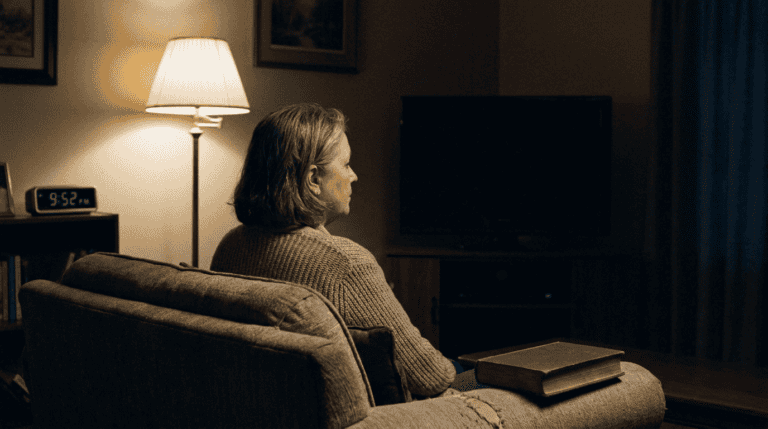
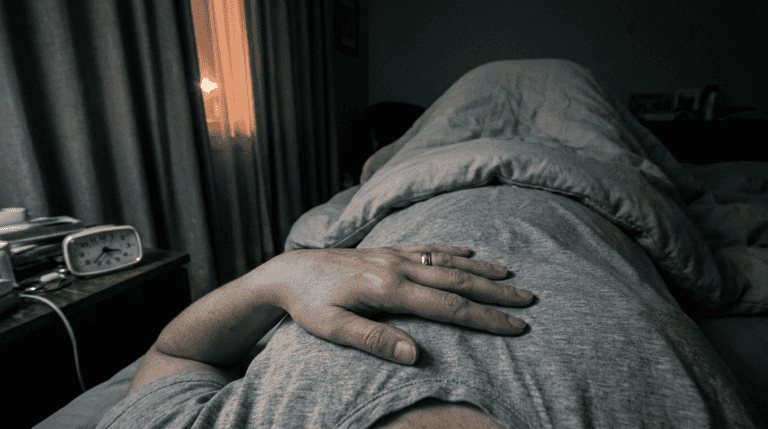
Two forty. You are awake before you know why, the way you are awake for a noise downstairs. Then the information arrives: the back of your nightshirt is cold and wet, and there is a damp patch under your shoulder blades that was warm about ninety seconds ago.
You lie still and do the arithmetic anyone does at two forty. Change it now and be properly awake, or lie on the dry half and hope.
By morning you have filed the whole episode under one heading. The night sweat woke you up. That is the sentence you would use if a colleague asked why you look tired, and it is the sentence almost every article about night sweats in perimenopause is built on.
The laboratory work points somewhere slightly different, and the difference is not academic. It changes which problem you are trying to solve. What follows is a reading of published sleep research on that question; we are not clinicians, the findings belong to Robert Freedman and to the SWAN investigators, and only the plain-English version is ours.
The short answer: when researchers wired women up and measured both things at once, hot flashes occurring during sleep tended to follow arousals rather than precede them.¹ The waking came first. The sweat came after. Something narrows the temperature range your body will tolerate without reacting, so a rise that would have gone unnoticed at thirty now triggers a full heat-dumping response. That mechanism is real and it is measurable. What it does not reliably explain is why you were awake at two forty in the first place.
There is a name worth having for the change underneath it, because you will want to explain it to somebody who tells you the bedroom is not that warm: the narrowed band. The band is the range of core temperature your body will sit inside without doing anything about it. It used to have room in it. It does not now, and a rise that would once have passed unnoticed is enough to trigger the whole response.
The skim version
- The range of core temperature your body tolerates without sweating or shivering is measurably narrower in women who get hot flashes. In one set of measurements it was 0.0°C in symptomatic women against 0.4°C in women without symptoms.¹
- Inside that narrow range, a very small rise in core temperature is enough to trigger the whole response.¹
- Recorded during sleep, flashes averaged around five per night and tended to arrive after an awakening rather than before it.¹
- The author of that work concluded that midlife sleep complaints should not be routinely attributed to hot flashes or to menopause.¹
- In a study of 1,449 women with frequent symptoms, the median total duration was 7.4 years, and it ran longer for women whose symptoms began early.²
The source for this piece
Robert R. Freedman, PhD
The physiologist whose laboratory work on hot flashes was carried out at Wayne State University School of Medicine, in the Departments of Psychiatry and Behavioral Neurosciences and of Obstetrics and Gynecology. He is the researcher who measured the thermoneutral zone directly, and who recorded flashes and awakenings on the same timeline.
What we read: Freedman, The American Journal of Medicine (2005),¹ alongside the SWAN duration analysis led by Nancy Avis in JAMA Internal Medicine (2015).²
Where to read it: The paper in full · The thermoneutral zone measurements · Wayne State research profile
Why do night sweats in perimenopause feel like the thing that woke you?
Because the evidence arrives in the wrong order. You surface, and within seconds you are holding physical proof of a reason. Wet fabric is a much better explanation than no explanation, so the mind takes it.
The underlying change is a narrowing. The thermoneutral zone is the band of core body temperature inside which your body does nothing at all: no sweating to cool down, no shivering to warm up. It is the quiet middle. In healthy adults it has some width to it, which is why you can move around a warm kitchen without breaking a sweat.
Robert Freedman’s laboratory measurements found that band effectively collapsed in symptomatic postmenopausal women, to 0.0°C, against 0.4°C in women who were not getting flashes.¹ Nothing about your temperature regulation has broken. The tolerances have tightened. A rise in core temperature that used to sit comfortably inside the middle now crosses a threshold, and once it crosses, the body does the correct and vigorous thing, which is to dump heat as fast as it can.
That is the mechanism, and it explains the sweat completely. It is the second finding that is less comfortable.
What happened when researchers measured the waking and the sweat together
Freedman recorded women through the night and captured both events with timestamps. Flashes during sleep averaged about 5.2 a night. And they tended to follow, rather than precede, the arousals and awakenings.¹
Read that slowly, because the order matters. The body was already surfacing. The heat response then arrived on top of it.
His conclusion was blunt: sleep complaints in women at midlife should not routinely be attributed to hot flashes or to menopause.¹ That is a sleep researcher telling clinicians not to close the file too early, and it is worth having in your hand before an appointment where somebody says the word hormones and reaches for the prescription pad.
What the research found
The Study of Women’s Health Across the Nation followed 1,449 women who reported frequent symptoms, meaning at least six days in the previous two weeks. The median total duration of those symptoms was 7.4 years. Women who were still premenopausal or early perimenopausal when symptoms began had a median duration above 11.8 years. Women whose symptoms did not start until after their final period had the shortest run, a median of 3.4 years.²
The limitation: this is observational and it rests on what women reported about the previous two weeks, not on anything measured overnight. Recall over a fortnight is imperfect, and the women who stayed in a long cohort study are not a random sample of everyone. It is the best available answer to how long, and it is an average built from self-report rather than a prediction about you.
If you have been reading the wet nightshirt as the whole story for two years, it is worth seeing what else is arriving at two forty alongside it. The Quiet Audit is a private ten-minute pass through what you are carrying into the night. Start here.
Was it the sweat, or was it the waking?
These look identical at three in the morning and they respond to completely different things, which is why the same advice works beautifully for one woman and does nothing for the next.
| The heat woke you | You woke, then found the heat | |
|---|---|---|
| What you notice first | A flush rising, usually before you are properly conscious | Being awake, then the wet fabric a moment later |
| Timing across the night | Scattered, often several times | Clustered, often the same hour most nights |
| What tends to help | Cooling the room and the bedding, and a clinical conversation about treatment | Everything that governs sleep continuity, including what happens at eleven |
| What makes it worse | A warm room and a heavy duvet you keep because it is the good one | Lying there working out how many hours are left |
Most women in the middle of this have some of both, which is fine. The point of separating them is that the second column has a much longer list of things you can change. The three o’clock pattern has its own mechanism, and if you are being told the whole thing is a stress hormone, that claim is worth examining before you act on it.
Five Things That Look Like This and Are Not This
Everything above protects the research. This part protects you, and it is the section most pages about night sweats leave out, because it invites you to consider that the transition may not be the whole story.
Five things produce a drenched nightshirt at two forty that is not the narrowed band. Each is worth raising rather than assuming.
- An overactive thyroid. Heat with a fast resting pulse, weight loss without trying, tremor and a wakefulness that has nothing to do with a flush.
- Medication. Some antidepressants, tamoxifen and certain diabetes medicines all cause sweats. The clue is that it started within weeks of a new prescription or a dose change.
- Obstructive sleep apnoea. Sweating alongside waking unrefreshed after a full night, and somebody else has usually noticed the breathing first.
- Infection. Ordinary and not exotic, but persistent night sweats with fever belong in a consulting room this week rather than in a bedding decision.
- Overnight low blood sugar. Relevant to anyone treated for diabetes, and it usually comes with shakiness and hunger on waking rather than with a flush.
None of these rules the narrowed band in, and none of them rules anything else out. They are questions worth putting to a clinician, not a list anyone can clear themselves on. A page cannot exclude a diagnosis and this one is not attempting to.
Who Else Has Measured This
One laboratory is never enough, and the gap in this one is real: Freedman measured physiology in small samples, not thousands of women over years. The cohort work fills exactly that gap.
Prof. Nancy E. Avis, PhD (Faculty · ResearchGate · Academia.edu), of Wake Forest University School of Medicine, led the analysis that followed 1,449 women reporting frequent symptoms and put the median total duration at 7.4 years — with a median above 11.8 years for women whose symptoms began while they were still premenopausal or early perimenopausal.²
Prof. Gail A. Greendale, MD (UCLA faculty · Doximity), of the University of California, Los Angeles, is a co-author on that analysis and has spent much of her career on how the transition unfolds over time rather than on how it feels in a single week.²
SWAN — the Study of Women’s Health Across the Nation, the multi-site cohort funded by the National Institutes of Health — is the reason a number like 7.4 years exists at all. It has followed the same women across the transition since the 1990s, which no laboratory study can do.
A physiology laboratory and a long cohort, pointing the same way from two directions. That is a stronger article than either alone.
The evidence arrives in the wrong order, and you file it accordingly.
What This Actually Changes
Not the treatment. Nothing here tells anyone what to take, and that conversation belongs with a clinician who knows your history.
What it changes is which problem you are solving, and for a woman who has spent two years cooling a bedroom that was never the issue, that is not a small correction. If the heat is what wakes you, the work is on temperature: the bedding, the room, and a conversation about treatment. If you are waking first and finding the heat second, the work is on everything that governs sleep continuity — and that list is considerably longer and considerably more in your hands.
It also changes what the wet nightshirt means. It has been functioning as proof that your body is failing at something basic. Under the narrowed band it is the opposite: a correct, vigorous response to a threshold that moved. The system is not broken. The tolerances tightened, and nobody told you.
When this belongs with a doctor
Book an appointment rather than changing the bedding if the sweats are drenching and come with fever, unexplained weight loss, or new pain; if they arrived suddenly rather than gradually; if they started within weeks of a new medication or a dose change; if anyone has noticed you stop breathing or gasp in your sleep; or if you are treated for diabetes and waking shaky and hungry rather than hot. None of those is a reason to panic. All of them are reasons not to solve it with a duvet.
What to Say at the Appointment, and What You Will Probably Hear Back
One sentence is rarely enough, because there is a standard reply waiting for it. Here is the sentence, the likely reply, and the second line. Short enough to read off a phone screen.
Short enough to read off a phone screen
Say: “I am waking most nights and then noticing the heat, rather than the heat waking me. I would like to treat those as two separate questions.”
If you hear “that is just the menopause”: “It may well be. I would still like thyroid and ferritin checked, my current medications reviewed for sweats, and a view on whether a sleep review is warranted, so those are excluded first.”
Neither is a demand and neither requests a named treatment. They are ordinary tests, a medication review and one referral question — and they are what turns ten minutes into a differential.
If what you want to take into that appointment is a clear account of what the last two years have actually contained, rather than a fortnight of half-remembered nights, the Quiet Audit is ten private minutes on exactly that. No programme, no advice, nobody sees your answers. Start here.
What to change first, and why it is the bedding rather than the thermostat
One thing, and it is unglamorous.
Sleep under two light layers instead of one heavy one. A sheet and a thin blanket, or a low-tog duvet with a spare folded at the foot of the bed. The reason is the narrowed band: your body is now reacting to differences of a fraction of a degree, and a single heavy layer gives you exactly two options, on and off. Two light layers give you four, and each adjustment is small enough that you can make it half asleep without becoming properly awake.
This is not a treatment for anything. It is a way of lowering the cost of the events you are still going to have, which matters because the expensive part of a night sweat is rarely the sweat. It is the twenty-five minutes of being upright and irritated afterwards.
Cool the room too if you can, though bedding beats room temperature for most people because it is adjustable at two forty without getting out of bed. And if you are waking at a consistent hour and only then noticing you are damp, the useful work is on the sleep itself rather than on the heat. There is an evidence-based rule for what to do while you are lying there, and it runs against the instinct.
Questions worth having an answer to
What causes night sweats in perimenopause?
A narrowed thermoneutral zone — the band of core temperature the body will tolerate without sweating or shivering. Laboratory measurements found that band effectively collapsed in symptomatic postmenopausal women, to 0.0°C against 0.4°C in women without symptoms, so a very small rise in core temperature is enough to trigger the full heat-dumping response.¹ The part that gets missed is the order: recorded during sleep, flashes averaged around 5.2 a night and tended to follow awakenings rather than precede them.¹
Is a night sweat the same thing as a hot flash?
Physiologically, yes. It is the same heat-dumping response, and the word changes only because you happen to be asleep and horizontal. The difference that matters is not the mechanism, it is that you cannot take a cardigan off at two forty.
How do I know whether it is menopause or something else?
Night sweats have other causes, including infection, some medications, thyroid problems and, less commonly, more serious conditions. Drenching sweats with weight loss, fever or new pain are not a wait-and-see situation. A pattern that tracks with a changing cycle, in your forties or fifties, alongside other familiar symptoms, usually is what it looks like. Your clinician settles this, not an article.
Does it help to know it lasts a median of 7.4 years?
For a lot of women it does, because the alternative belief is that it should have stopped by now and something is wrong. It is also worth knowing that the median hides an enormous range, and that starting early tends to mean a longer run.²
Should I ask about treatment?
That is a conversation to have rather than one to decide alone, and there are effective options. What is reasonable to bring to the appointment is the distinction above: whether the heat is waking you, or whether you are waking and then finding the heat. Those point at different treatments, and nobody can tell them apart for you. The treatment landscape is set out separately here.
The one move
Tonight, swap the single heavy duvet for two light layers, and keep the spare at the foot of the bed where you can reach it without sitting up. Then, for the next week, note only one thing when you wake: whether you noticed the heat first, or the waking first.
Seven nights, one observation, no equipment. That is the whole instruction.
Informational, not medical advice. Drenching night sweats with fever, weight loss or new pain, and any symptom that worries you, belong with your clinician.
Where to Go Next
In order, and each for a reason.
1. If the waking has settled into a fixed hour, start with the three o’clock pattern and its own mechanism — that is the first column of the table above, examined properly.
2. Then the evidence-based rule for what to do while you are lying there, because it runs against the instinct and it is the highest-value change available on the waking side.
3. Then what the treatment landscape actually contains, which is the conversation to have once you know which of the two you are treating.
Seven nights of noticing which came first will tell you more than another article will.
References
1. Freedman, R. R. (2005). Hot flashes: behavioral treatments, mechanisms, and relation to sleep. The American Journal of Medicine, 118(12 Suppl 2), 124-130. Read the paper
2. Avis, N. E., Crawford, S. L., Greendale, G., et al. (2015). Duration of Menopausal Vasomotor Symptoms Over the Menopause Transition. JAMA Internal Medicine, 175(4), 531-539. Read the study
3. Freedman, R. R., & Krell, W. (1999). Reduced thermoregulatory null zone in postmenopausal women with hot flashes. American Journal of Obstetrics and Gynecology, 181(1), 66-70. Read the measurements
On the researchers. Robert R. Freedman is a research physiologist with a PhD, not a physician, and his hot-flash work was conducted at Wayne State University School of Medicine. Nancy Avis holds a PhD; Gail Greendale holds an MD. The distinction matters when reading a recommendation: none of them has made one here, and neither have we.
Sourcing, disclosure and disclaimers
This is not medical advice. Blue Leaf Journal publishes general information for a general readership. Nothing here is a diagnosis, a treatment recommendation, or a substitute for care from a clinician who knows your history.
We are not clinicians. Blue Leaf Journal is an independent publication. We read published research and translate it. The findings belong to the researchers and institutions named and linked above; the plain-English rendering is ours, and so is any error in it.
No affiliation and no endorsement. Blue Leaf Journal is not affiliated with Robert R. Freedman, Nancy E. Avis, Gail A. Greendale, Wayne State University, Wake Forest University, the University of California, Los Angeles, the Study of Women’s Health Across the Nation or the National Institutes of Health. None of them has reviewed, approved or endorsed this article, and none of them is responsible for it. They are cited because their published work is the evidence for what it says.
No commercial relationship. Nobody named above paid for or was paid for this coverage. There are no affiliate links, no sponsored placements and no gifted products in this article. No bedding, device or treatment mentioned here is sold by us or by anyone paying us.
How this was checked. Every figure above is drawn from the primary papers, each linked in the references, and can be verified there. Sources were checked on 27 August 2026. If you find something we have got wrong, write to norawhitfield@blueleafjournal.com and we will correct it and say that we did.
Nora Whitfield writes the Body desk at Blue Leaf Journal, where the working rule is that a mechanism you can name is easier to live with than one you cannot. She reads the limitations section before the conclusion, and passes on what she finds there.
Written by Nora Whitfield for Blue Leaf Journal. Updated: 27 August 2026.