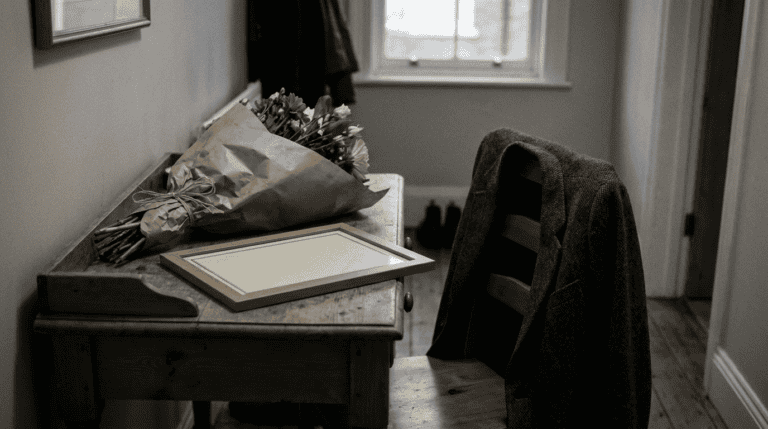

The Kitchen at 11 P.M. and Something You Said in 2009
Mind · The Reading Room, Vol. 15 · 10 min read · What involuntary retrieval is, why the wince is being generated now rather than preserved, and the fifteen seconds that shorten it
Your shoulders go up, in your own kitchen, over a sentence nobody else alive remembers.
You are rinsing one glass. The dishwasher is already running, the house has gone quiet in that particular way it goes quiet after ten, and out of nowhere your own voice comes back at you saying something you said at a work dinner in 2009.
Not something terrible. Something slightly off. A joke that landed a beat wrong. A name you got confused. The moment you talked thirty seconds too long and watched a face change across the table. What follows is a reading of published memory research on exactly that; we are not clinicians, the findings belong to Dorthe Berntsen and her colleagues, and only the plain-English version is ours.
The short answer: if you have ever stood at a sink and wondered why do I replay embarrassing memories nobody else noticed at the time, this is involuntary retrieval — a documented mode of remembering in which a specific past episode arrives without any attempt to recall it. Memory researcher Dorthe Berntsen has shown these unbidden memories run on the same episodic system as deliberate recall, but arrive more specific, less connected to your life story, and with a stronger emotional reaction at the moment they land.¹
There is a name worth having for what actually arrives, because it explains both the sting and the fix: the unfinished file. What surfaces is a fragment with the emotional volume turned up and the context stripped out — the moment, without the rest of the evening, without the four years you went on working with that person, without her asking you to write her reference. You are not being shown the episode. You are being shown a clip.
The skim version
- Involuntary autobiographical memories come to mind with no preceding attempt at retrieval. You did not summon this.¹
- They use the same episodic memory system as deliberate remembering, so a rising rate of them says nothing about your memory failing.¹
- They arrive more specific than memories you fetch on purpose, which is why the detail is so vivid.³
- They also carry more emotional reaction at the moment of recall than the same memory does when retrieved deliberately.¹
- Berntsen’s work found these memories are typically less relevant to your identity, not more. The wince is not a verdict on who you are.¹
- Across large samples they are predominantly positive. You notice the cringe because it arrives with a body response; the pleasant ones pass through unrecorded.¹
The source for this piece
Prof. Dorthe Berntsen, PhD
Professor of Psychology at Aarhus University in Denmark and founding director of its Center on Autobiographical Memory Research, a national centre of excellence built around this exact question. She is the researcher who took a phenomenon psychology had ignored for a century — memories that arrive uninvited — and turned it into a measurable, mainstream field. Almost everything reliable that can be said about the kitchen at eleven traces back to her programme.
What we read: Berntsen, Current Directions in Psychological Science (2010); Rubin and Berntsen, Memory & Cognition (2009); Berntsen and Hall, Memory & Cognition (2004).¹²³
Where to follow her work: Aarhus University · LinkedIn · Google Scholar
Why they arrive at random moments
Because almost nothing about the moment is random, and you were not looking for the memory. Involuntary autobiographical memories are triggered associatively, by something in your immediate surroundings that overlaps with the original scene. A cadence in someone’s voice. The particular yellow of a kitchen light. The smell of a room. Berntsen’s research describes this associative, unplanned retrieval as the defining feature of the whole category.¹
This is why they cluster in the low-demand parts of your day. The shower. The drive. The eleven minutes after the house goes quiet. Not because those hours are emotionally dangerous, but because a mind that is not being asked to do anything has bandwidth to notice a cue it would have walked straight past at 2 p.m.
Definition: an involuntary autobiographical memory is a memory of a personal experience that comes to mind spontaneously, with no preceding attempt to retrieve it. It runs on the same episodic system as deliberate recall and follows the same rules of encoding — it simply arrives without being asked.¹
Proust built a novel on this. He called it a madeleine. You call it standing at the sink feeling twenty-six again.
Why the memory feels worse now than it did then
Because the emotional reaction and the memory are not the same age. Berntsen’s review found that involuntary memories involve more emotional reaction at the time of recall than voluntary ones do.¹ You are not feeling 2009’s embarrassment preserved in amber. You are generating a fresh one, right now, at the sink, with your current standards applied to a woman who did not have them yet.
That is the part worth sitting with. The version of you being judged in that replay had less information, less standing, and a room full of people she was still trying to read. The version of you doing the judging has sixteen more years of knowing how that dinner should have gone.
It is an unfair trial and you are running it against yourself in a quiet kitchen.
There is a second reason these particular scenes come back. Bad information gets processed more thoroughly than good, which is why a single critical comment outlives nine compliments. If that pattern sounds familiar, it is the same machinery behind only remembering the one piece of criticism from a review that went well. The dinner in 2009 got filed with more detail than the four dinners where you were funny and easy and everyone left happy.
Why it is always 2009 and never last March
Because autobiographical memory is not evenly distributed across a life. Researchers have documented what is called the reminiscence bump: when people over forty are asked to recall personal events, memories from roughly their late teens through their early thirties come back disproportionately often, and the effect holds across cultures.⁴
Those were the years when almost everything was happening for the first time. First proper job, first time being the only woman in a room, first time being introduced by a title. Novel events get encoded with far more detail than the four hundredth version of a similar meeting, and detailed memories are easier for a stray cue to catch.
Which also explains a quiet, uncomfortable part of this. The mistakes that come back are almost never professional errors. They are social ones. A misjudged tone, a laugh that came too early, a moment of being too keen in a room that was being cool. Those were the years you were being read, and some part of you filed every reading.
If the replays mostly feature a version of you being read and found wanting, the Quiet Audit is ten private minutes on who taught you to watch for that. No programme, no advice, nobody sees your answers. Start here.
Is this a sign something is wrong with my memory?
No, and the research points the other way. Involuntary memories operate on the same episodic memory system as voluntary, strategic remembering, following the same rules of encoding and maintenance.¹ Berntsen’s argument is that this is a basic mode of remembering — one of the three kinds Ebbinghaus described in 1885 — and that modern psychology simply stopped looking at it for a century.
Researchers have measured how often these arrive across the whole adult lifespan.² They are not an aberration and they are not a symptom. They are how memory idles.
What tends to confuse women in their fifties is the timing. The replays often get louder in the same years that word-finding gets slower and names go missing, so the two feel like one story about a mind coming apart. They are unrelated systems. One is retrieval running smoothly enough to fire on a faint cue. The other is a change in recall speed with an entirely separate explanation.
What the research found
Across a programme running more than two decades, Berntsen established four things about unbidden memories: they are triggered associatively by cues in the environment; they run on the same episodic system as deliberate recall; they are more specific than memories retrieved on purpose; and they carry more emotional reaction at the moment of recall.¹³ The frequency has been measured across the adult lifespan rather than inferred.²
The limitation, stated plainly: much of this literature relies on diary and questionnaire methods — people recording their own memories as they arrive — which is the only practical way to study something spontaneous, and which depends on people noticing and reporting accurately. Laboratory work in this field is comparatively recent. And no study here was built around women in midlife rinsing a glass at eleven at night; the mechanism is well evidenced, the specific application is ours, and the finishing move below is a reasonable inference from it rather than a tested intervention.
Five Things That Look Like This and Are Not This
Everything above describes ordinary memory doing an ordinary thing. This part is the other possibility, because a few conditions produce something that feels similar from the inside and responds to something quite different.
- Trauma-related intrusions. Fragments of a genuinely frightening event arriving as though happening now, rather than a complete scene being remembered, with a physical response out of proportion to a memory. That is a different phenomenon with its own effective treatments and belongs with a clinician, not a kitchen exercise.
- Rumination in depression. Not a scene that arrives and passes, but hours of looping you cannot interrupt, with a flatness underneath it that stays in the gaps. The distinguishing feature is duration and the mood between episodes.
- Intrusive thoughts of the obsessive kind. Repetitive, distressing, and typically accompanied by an urge to neutralise them with a check or a ritual. Common, treatable, and frequently unmentioned for years out of embarrassment.
- Short sleep. It does not create the replays, but it lengthens them and lowers your tolerance for them. If the nights are broken, the bed may be part of the mechanism.
- More quiet hours than you used to have. The commonest explanation of all for a sudden increase, and the least alarming. Waking at four gives a cue-hungry mind two hours it did not previously have.
None of these is ruled out by the fifteen seconds below, and the fifteen seconds are safe alongside any of them. But the first three are worth twenty minutes with someone qualified rather than another year of managing it alone.
Who Else Has Measured This
One research programme, however dominant, is one group. Three others bear on the same ground.
Prof. David C. Rubin (Duke University · Wikipedia · Scholar) at Duke University, working with Berntsen, measured how often voluntary and involuntary memories actually arrive across the whole adult lifespan — which is what moved this from an interesting observation to a quantity.² It is the study that lets anyone say with confidence that this is normal rather than notable.
Prof. Martin Conway (1952–2022, in memoriam — Wikipedia) and colleagues established the reminiscence bump across cultures, which is why the scene at the sink is so reliably from the decade when you were still assembling the woman you would become rather than from last spring.⁴
Nicole Hall, with Berntsen, did the work establishing that these memories are more specific than deliberately retrieved ones — the finding that explains why the detail is so unreasonably sharp for an event nobody else remembers at all.³
A frequency study, a cross-cultural distribution study and a specificity study. Together they say the same unglamorous thing: this is a normal function, running normally, at an inconvenient hour.
You are not being shown the episode. You are being shown a clip.
What This Actually Changes
Not whether they arrive. Nothing stops them arriving, and anyone promising otherwise is selling something.
What it changes is what the wince counts as. Right now it is being read as data — as though the fact that this memory keeps surfacing means it matters, means it was worse than you thought, means some part of you has been keeping score. Berntsen’s finding is the opposite: involuntary memories tend to be less relevant to identity than the ones you retrieve on purpose.¹ The frequency is a fact about cue overlap in your kitchen. It is not a fact about the significance of the dinner.
It also changes the tool. If there is no argument being made, then arguing back is the wrong response — which is why every attempt to reason with it has failed, and why that failure was never evidence about your self-esteem.
What to Say — to Yourself, and at an Appointment
Two scripts, and the first one is the whole intervention.
Short enough to say at a sink
To yourself, out loud if you are alone: “That happened, and it ended, and here is how.” Then name the ending in concrete terms. The dinner ended. Someone paid the bill. You drove home. You worked with her for four more years and she asked you to write her reference.
If the urge is to apologise sixteen years later: “This is my discomfort. Handing it to her makes it hers.” An apology now asks the other person to retrieve something they have not thought about since, then reassure you about it.
At an appointment, if it has escalated: “I am getting intrusive memories many times a day, they last hours rather than seconds, and I have started avoiding things because of what might surface.”
If the replays are the surface of an older habit of auditing yourself for other people, the Quiet Audit is ten private minutes on where that habit came from and who taught it to you. Nobody sees your answers. Start here.
Why finishing works better than arguing
Most advice here tells you to challenge the thought. That is the wrong tool, because there is no argument being made. The memory is not claiming anything. It is just showing you a room.
So do not argue with it. Finish it instead. Take fifteen seconds. That is the whole thing.
The reason this works is structural rather than emotional. An involuntary memory hands you a fragment with the emotional volume turned up and the context stripped out. Supplying the ending gives your mind the rest of the episode, so there is less left hanging for the cue to catch on next time. You are not trying to feel better about 2009. You are finishing the file.
It will not stop them arriving. What it does is shorten the tail — from four minutes of standing there with your shoulders around your ears to about forty seconds.
If this is happening mostly after midnight rather than at the sink, that is a different mechanism with a different fix, and it is worth reading about why the meeting reconvenes at 3 a.m. instead. And if the replays are recent conversations rather than old ones, the habit underneath is rehearsing work conversations after they are over, which responds to something else entirely.
When this belongs with a clinician
Book an appointment rather than managing it alone if the memories arrive as fragments with no context rather than as complete scenes, or dozens of times a day; if they last hours of looping you cannot interrupt rather than seconds; if the content is genuine trauma arriving as though it were happening now; if you have started avoiding places, people or work because of what might surface; or if the frequency and distress have been steadily escalating over months. A flatness that stays in the gaps between episodes points at something with its own treatment. If you are having thoughts of harming yourself, speak to someone today rather than reading further.
Questions people ask about this
Why do I replay embarrassing memories from decades ago?
Because involuntary autobiographical memory is a normal mode of remembering: a specific past episode arriving with no attempt to recall it, triggered associatively by a cue in your surroundings.¹ It clusters in low-demand hours because that is when a mind has bandwidth to notice a faint cue. The memory is usually from your late teens to early thirties because that is where the vivid, novel material was encoded.⁴
Why do embarrassing memories come back more than good ones?
They probably do not, but you notice them more. Berntsen’s research found involuntary memories are predominantly positive across large samples.¹ The pleasant ones pass through without a physical reaction, so they leave no trace in your day. The cringe arrives with a body response, which is what makes it memorable as an event.
Does this get worse in perimenopause?
There is no good evidence that involuntary retrieval itself increases with hormonal change. What does change is sleep, and broken sleep produces more of the quiet, unoccupied waking hours where these memories surface. The mechanism is opportunity rather than hormones.
Why is the memory so much more detailed than things I did last week?
Research on the episodic nature of involuntary memories found they tend to be more specific than memories retrieved deliberately.³ You are comparing a highly specific involuntary memory against a general impression of last Tuesday. Those are two different kinds of recall, and one of them was built to be vivid.
Should I apologise to the person if I can still remember it?
Almost never, and the impulse is worth examining. Sixteen years on, an apology for a mistimed joke asks the other person to retrieve something they have not thought about since, then reassure you about it. That is your discomfort, handed to them to hold.
The one move
When the scene arrives, do not argue with it. Say one sentence — “That happened, and it ended, and here is how” — and then name the ending in concrete terms. Fifteen seconds.
You are not trying to feel better about 2009. You are finishing the file.
Where to Go Next
In order, and each for a reason.
1. If it happens mostly after midnight, the 3 a.m. version has its own mechanism — and the fix there is about the bed, not the memory.
2. Then what the body is doing before the thoughts arrive, because a replay that will not stop is often riding on arousal that started earlier.
3. Then why one piece of criticism outlives nine compliments, which is the same filing habit seen from the other side.
Nobody else alive remembers the sentence. That is not a consolation prize — it is the finding.
References
1. Berntsen, D. (2010). The Unbidden Past: Involuntary Autobiographical Memories as a Basic Mode of Remembering. Current Directions in Psychological Science, 19(3), 138–142. Read the paper
2. Rubin, D. C., & Berntsen, D. (2009). The frequency of voluntary and involuntary autobiographical memories across the life span. Memory & Cognition, 37, 679–688. Read the paper
3. Berntsen, D., & Hall, N. M. (2004). The episodic nature of involuntary autobiographical memories. Memory & Cognition, 32, 789–803. Read the paper
4. Conway, M. A., et al. (2005). A Cross-Cultural Investigation of Autobiographical Memory: On the Universality and Cultural Variation of the Reminiscence Bump. Journal of Cross-Cultural Psychology. Read the paper
On the researcher. Dorthe Berntsen is a cognitive psychologist and memory researcher, not a clinician, and nothing in her published work is medical advice for an individual. Her university page lists the full publication record behind the summaries above, which is where the descriptions in this piece were checked. The finishing line offered here is our inference from her findings, not an intervention she has tested.
Sourcing, disclosure and disclaimers
This is not medical advice. Blue Leaf Journal publishes general information for a general readership. Nothing here is a diagnosis, a treatment recommendation, or a substitute for care from a clinician who knows your history. Intrusive memories of a traumatic event are a distinct phenomenon with effective treatments, and this page is not one of them.
We are not clinicians. Blue Leaf Journal is an independent publication. We read published research and translate it. The findings belong to the researchers and institutions named and linked above; the plain-English rendering is ours, and so is any error in it.
No affiliation and no endorsement. Blue Leaf Journal is not affiliated with Dorthe Berntsen, David Rubin, Martin Conway, Nicole Hall, Aarhus University or Duke University. None of them has reviewed, approved or endorsed this article, and none of them is responsible for it. They are cited because their published work is the evidence for what it says.
No commercial relationship. Nobody named above paid for or was paid for this coverage. There are no affiliate links, no sponsored placements and no gifted products in this article.
How this was checked. Every claim above is drawn from the primary papers, each linked in the references, and can be verified there. Where the practical move is our inference rather than a tested intervention, we have said so in the body rather than implied a study behind it. Sources were checked on 27 August 2026. If you find something we have got wrong, write to norawhitfield@blueleafjournal.com and we will correct it and say that we did.
Nora Whitfield writes the Mind desk at Blue Leaf Journal — the loops, the replays, and the thoughts that arrive louder than the evidence behind them. She has a 2011 conference dinner that still turns up about twice a year, and she now finishes it in under a minute.
Written by Nora Whitfield for Blue Leaf Journal. Updated: 27 August 2026.