
You Finally Sat Down and Your Legs Started Up
Body · The Reading Room, Vol. 80 · 7 min read · The blood test the sleep medicine guideline names by number, and why a “normal” ferritin can still be too low
Based on the published research of John W. Winkelman, MD, PhD — Chief, Sleep Disorders Clinical Research Program, Massachusetts General Hospital, and Professor of Psychiatry, Harvard Medical School, lead author of the American Academy of Sleep Medicine’s clinical practice guideline. Faculty profile
Restless legs in menopause is a documented pattern, not restlessness. What the sleep medicine guideline says, and the blood test worth asking for by name.
You have tried the magnesium. The tonic water someone’s sister swore by. The pillow between the knees, the stretch a physiotherapist once gave you for something else entirely, the second glass of water, the hot bath, the cold shower. None of it did much. You have been treating this as a habit; it has a clinical definition and diagnostic criteria.
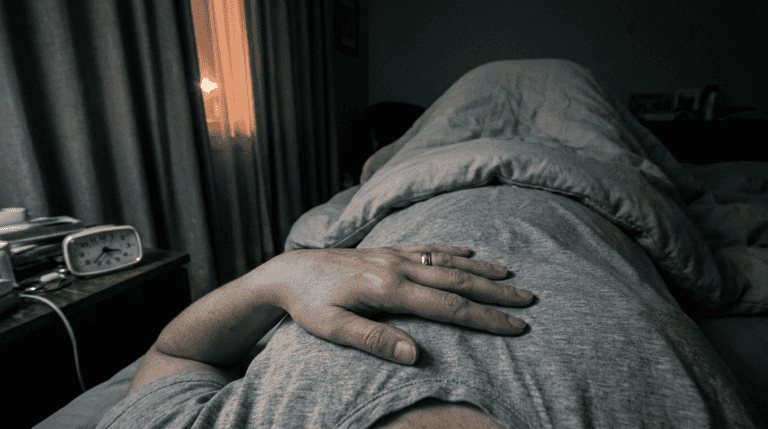
Ten forty. The house is finally quiet. You finally sat down and your legs started up.
The short answer: restless legs in menopause is a recognised pattern, and the mechanism most likely to be fixable is iron. The American Academy of Sleep Medicine’s clinical practice guideline says restless legs syndrome is an urge to move the legs that comes on with stillness, eases with movement, and is worst in the evening or at night, and that there is no objective test for it. What there is instead is a blood test that changes the treatment, and most women never get offered it by name.¹
The skim version
- Restless legs syndrome is defined by an urge to move that starts with stillness, is relieved by moving, and peaks at night.¹
- It is roughly 50% more prevalent in women than men, and prevalence and severity both rise around menopause.¹³
- A Swedish study of 5,000 women found higher rates among those with night sweats during the menopausal transition.²
- The guideline tells clinicians to test ferritin and transferrin saturation, in the morning, with no iron-containing food or supplements for 24 hours beforehand.¹
- The treatment threshold is far higher than the usual lab cutoff, which is why a normal-looking result can still be too low.¹
In this article: Why it only happens at night · The menopause link · The test to ask for by name · The three-night note · FAQ
Informational, not medical advice. Please see your clinician.
Why do my legs only do this when I finally stop moving?
Because stillness is part of the definition, not a coincidence of timing. The sleep medicine guideline describes it as an urge to move one or both legs, and sometimes the arms, that arrives when you are immobile, is relieved by movement, and is most prominent in the evening or at night.¹ That is why nothing shows up while you are loading the dishwasher and everything shows up in the second half of a film.
Which also explains the cruellest part of the arrangement. The only reliable relief is to get up, and getting up is the one thing that undoes the sleep you were trying to get. Nine out of ten people with this have trouble falling asleep or staying asleep, and that insomnia, rather than the legs themselves, is usually what does the real damage.¹
The sensation is famously hard to describe, which is part of why it goes unreported for years. Women reach for crawling, fizzing, pulling, a need to stretch that stretching does not satisfy. There is no blood test that says yes, this is it. Diagnosis rests on a careful clinical history, which in practice means it rests on how well you describe it in a ten-minute appointment.¹
Worth knowing before you go: several other things look like this from the outside. The guideline names neuropathy, positional discomfort, joint discomfort and ordinary night cramps among the conditions that can mimic it in adults.¹ Cramps are the common mix-up, and they behave differently. A cramp is a hard, painful, visible contraction that arrives without warning. This is a sensation with an urge attached, and the urge is the diagnostic part.
What the research found
The AASM’s clinical practice guideline, led by Winkelman and colleagues, recommends iron supplementation in adults with restless legs syndrome when serum ferritin is below 75 ng/mL or transferrin saturation is below 20% — a threshold well above where most laboratories flag ferritin as low.¹
The limitation: a clinical practice guideline synthesises the best available trial evidence into a recommendation; it is not itself a single new study, and the guideline is explicit that there is no objective diagnostic test for restless legs syndrome, so diagnosis still depends on how well a patient’s history is taken.¹
Definition: restless legs syndrome is an urge to move the legs that appears during stillness, is relieved by moving, and is at its worst in the evening or at night.¹
Is there really a link between restless legs in menopause and hormones?
There is an association, well documented, and a mechanism that is still being argued about. Both halves are worth having straight, because the honest version is more useful than the confident one.
The association first. In a study of 5,000 randomly selected Swedish women aged 18 to 64, with a 70% response rate, prevalence rose with age, and rates were higher among women who reported night sweats during the menopausal transition. Interestingly, the same pattern did not appear among the women taking hormone therapy.² A 2020 review looking at why women are more prone to this in the first place notes the same paradox from the other end: pregnancy raises risk, and so does menopause, which points at reproductive hormones without producing a tidy story about them.³
The mechanism, as best it is understood, runs through iron rather than oestrogen alone. Iron is needed for dopamine signalling in specific regions of the brain, and dopamine is what governs the whole system this sits in. Both iron levels and oestrogen levels influence that transmission, which is one proposed reason women carry so much more of this than men.³ The review’s own suggestion is that changes in oestrogen, rather than any absolute level, may be what sets symptoms off, which fits a perimenopause that is defined by fluctuation rather than decline.
There is also a plainer explanation that gets overlooked. Perimenopausal bleeding is frequently heavier and less predictable, and heavy periods deplete iron stores over months and years. A woman can arrive at 51 with a haemoglobin that has never once been flagged and iron stores that ran down quietly the whole time.
If several unrelated-looking things arrived within the same two years, that clustering is ordinary rather than suspicious. The joint pain that shows up in the same window works on comparable logic: a hormone acting on tissue nobody thinks of as hormonal.
Ten forty. The house is finally quiet. You finally sat down and your legs started up.
If this is one more thing you have decided is not worth an appointment, the Quiet Audit is ten minutes on the rest of that list. Start here.
| Restless legs | Night cramps | Ordinary fidgeting | |
|---|---|---|---|
| What it feels like | An urge, with a sensation under it | A hard, painful contraction | Nothing much. Just movement. |
| What sets it off | Sitting or lying still | Arrives with no warning | Boredom, thinking, habit |
| What relieves it | Moving. Reliably. | Stretching the muscle out | Nothing needs relieving |
| When it peaks | Evening and night | Usually deep in the night | Any time |
| What it costs | Sleep onset, most nights | A few bad minutes | Nothing |
The source for this piece
John W. Winkelman, MD, PhD
Chief of the Sleep Disorders Clinical Research Program at Massachusetts General Hospital and Professor of Psychiatry at Harvard Medical School. Lead author of the American Academy of Sleep Medicine’s clinical practice guideline on treating restless legs syndrome.
What we read: the 2024 AASM clinical practice guideline on treatment of restless legs syndrome and periodic limb movement disorder, which underlies the testing and treatment thresholds this piece describes.¹
Where to follow his work: Faculty profile
Who else has measured this
The pattern this guideline formalises has been documented from other directions too.
Jan Wesström, MD, PhD, of Uppsala University, led the 2008 study of 5,000 Swedish women cited above, one of the first large population surveys to link restless legs syndrome specifically to the menopausal transition and night sweats.² Published research
Mary V. Seeman, MD, Professor Emerita of Psychiatry at the University of Toronto, authored the 2020 review on why women are more prone to restless legs syndrome cited above, proposing the oestrogen-fluctuation mechanism this piece describes. She died in 2024; her research remains part of the field’s working understanding of the sex difference.³ In memoriam
What is the one test worth asking for by name?
Serum ferritin, together with transferrin saturation. The number that tends to get checked instead is haemoglobin, and haemoglobin can sit comfortably mid-range while your stores are running on fumes. One tells you what is circulating today. The other tells you what is left in the cupboard.
The guideline is unusually specific about how it should be done. Iron studies should ideally be taken in the morning, avoiding all iron-containing supplements and foods for at least 24 hours before the draw.¹ That detail matters more than it sounds. A ferritin taken at four in the afternoon, two hours after a supplement, can come back reassuring and be wrong.
Then there is the threshold, which is the part that catches most women out. In adults with restless legs syndrome, the guideline recommends iron supplementation when serum ferritin is below 75 ng/mL or transferrin saturation is below 20%.¹ Many laboratories flag ferritin as low only well beneath that, often around 15 to 30. So a result can sit inside the normal range on the printout, carry no asterisk, and still be under the number that would change your treatment.
Two things this does not mean. It does not mean start taking iron. Iron loading carries its own risks, the guideline’s route runs through a clinician reading both numbers together, and some people need intravenous iron rather than tablets because tablets are poorly absorbed once stores are past a certain point.¹ It also does not mean iron is the whole answer for everyone; clinically significant cases, defined as more than twice a week with at least moderate distress, affect an estimated 2-3% of adults, and treatment beyond iron is a separate conversation.¹
It means you can walk in with two words and a time of day, which is a much better appointment than the one that starts with my legs feel strange at night.
The three-night note
Before the appointment, spend about ninety seconds a night for three nights writing four things in your phone. Anchor it to putting the phone on the charger, so you do not have to remember separately.
- The time it started, roughly.
- What you were doing when it did. Sitting, lying, watching something.
- What you did about it, and whether that worked.
- What time you actually got to sleep.
Then one line at the end, written once: Can we check ferritin and transferrin saturation, morning draw, and can I see the actual numbers.
That last clause is the one that earns its place. Asking for the numbers rather than the verdict means you are not relying on someone else’s lab-range cutoff, which may be nowhere near the one the sleep guideline uses.
An honest note about what this will not do. Three nights of notes will not fix your legs, and if the pattern has been going on for years it may take more than one appointment to get anywhere. What the notes do is convert a vague nightly complaint into something a clinician can act on in the time available, which is often the actual bottleneck. If the sleep loss has been running long enough that the days have gone grey, the midlife energy drains that get misread as laziness covers what accumulates underneath. And if the bigger problem is surfacing at three rather than getting off at eleven, waking at 3 a.m. runs on a different mechanism and takes a different approach.
Frequently asked questions
Does restless legs go away after menopause?
Not dependably. Prevalence rises with age rather than resolving at a particular point, and the 2020 review notes that menopause increases both prevalence and severity.³ It is better treated as something to investigate than something to wait out.
Should I just take an iron supplement and see?
No. The guideline route is to test ferritin and transferrin saturation first and let the numbers direct the dose and the form, because too much iron carries its own risks and oral iron is poorly absorbed once stores pass a certain level.¹ Get the test, then decide with your clinician.
Why does moving help for a minute and then stop working?
Because relief through movement is a feature of the condition rather than a treatment for it. The urge returns once you are still again, which is why the evening turns into a cycle of getting up and lying down rather than one bad episode.
Could this be something else?
It could. Neuropathy, joint discomfort, positional discomfort and ordinary night cramps all resemble it, and there is no objective test to separate them.¹ That is exactly why the description you give matters, and why writing it down beforehand is worth the ninety seconds.
Is it connected to the other things that started around the same time?
Possibly. Joints, sleep, mood and the internal thermostat all start behaving differently in roughly the same window, which makes any single symptom easy to write off as general decline. One specific pattern usually gets further in an appointment than a list of six vague ones.
The one move
There is a version of this that is not about legs at all: the years of not mentioning something because it seemed too small to take up an appointment with. The Quiet Audit is about ten minutes of questions about what you have been carrying without counting it, including the symptoms you have decided are not worth anyone’s time. Nobody sees your answers.
Tonight will probably go the same way. But there are two words to take to the appointment now, and a time of day to take them at. Start here.
On the researcher. John W. Winkelman is a sleep physician and researcher, not your treating clinician: the guideline describes population-level evidence and testing thresholds, and does not replace an individual diagnosis and treatment plan.
Sourcing, disclosure and disclaimers
This is not medical advice. Blue Leaf Journal publishes general information for a general readership. Nothing here is a diagnosis, a treatment recommendation, or a substitute for care from a licensed clinician who knows your history. Please see your clinician.
We are not clinicians. Blue Leaf Journal is an independent publication. We read published research and translate it. The findings belong to the researchers named and linked above; the plain-English rendering is ours, and so is any error in it.
No affiliation and no endorsement. Blue Leaf Journal is not affiliated with John W. Winkelman, Jan Wesström, Mary V. Seeman’s estate, the American Academy of Sleep Medicine, Massachusetts General Hospital, Harvard Medical School, Uppsala University, or the University of Toronto. None of them has reviewed, approved or endorsed this article, and none of them is responsible for it. They are cited because their published research is the basis for what it says.
No commercial relationship. Nobody named above paid for or was paid for this coverage. There are no affiliate links, no sponsored placements and no gifted products in this article.
How this was checked. Every figure above is drawn from the primary sources, each linked in the references, and can be verified there. Sources were checked on 7 September 2026. If you find something we have got wrong, write to norawhitfield@blueleafjournal.com and we will correct it and say that we did.
References
1. Winkelman, J.W., et al. Treatment of Restless Legs Syndrome and Periodic Limb Movement Disorder: An American Academy of Sleep Medicine Clinical Practice Guideline. Journal of Clinical Sleep Medicine, 2024. aasm.org
2. Wesström, J., et al. (2008). Restless legs syndrome among women: prevalence, co-morbidity and possible relationship to menopause. Climacteric, 11(5), 422–428. pubmed.ncbi.nlm.nih.gov/18781488
3. Seeman, M.V. (2020). Why are women prone to restless legs syndrome? International Journal of Environmental Research and Public Health, 17(1), 368. pubmed.ncbi.nlm.nih.gov/31935805
Nora Whitfield writes for Blue Leaf Journal, where the working rule is that a mechanism you can name is easier to live with than one you cannot. She reads the limitations section before the conclusion, and passes on what she finds there.
Written by Nora Whitfield for Blue Leaf Journal. Updated: 7 September 2026.