
The Three Good Days That Made You Uneasy
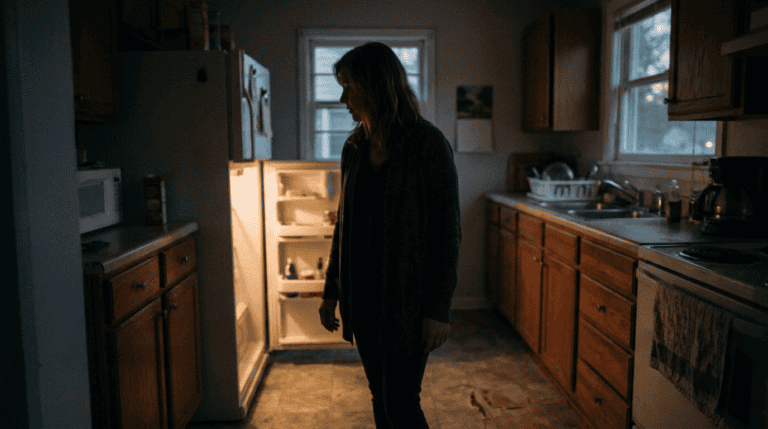
Three good days in a row. The report went through with no comments on it. Your daughter rang on a Tuesday for no particular reason. Nobody needed anything urgent, and the week was, by any honest measure, fine. Then somewhere around Wednesday evening, standing at the sink running water over a plate you had already rinsed, you noticed you were braced.
Not for anything you could name. Just braced. That low hum of waiting for something to go wrong, which turns up most reliably in the stretches when nothing actually is.
Most people file this under superstition, or under being a pessimist, and then feel faintly ashamed of it. It is neither. It has a mechanism, it has been measured in a lab, and the mechanism explains something that superstition cannot: why the unease gets worse during the calm, rather than better.
The short answer: for some people, worry works as a buffer. Staying slightly braced keeps you at a steady level of low-grade tension, so that when bad news does land, it does not arrive as a drop. Calm feels risky because calm is the height you would fall from.¹
Key takeaways
- The unease that shows up during good stretches works like insurance. Keeping your emotional floor low means nothing has far to fall.¹
- Researchers call the underlying pattern contrast avoidance. What gets avoided is the sudden shift into a bad feeling, rather than the feeling itself.¹
- This is why relaxation leaves some people feeling worse, which has been measured directly.²
- The strategy works, in the narrow sense that it does soften the jolt. It just charges you the whole week for it.
- The useful move is to finish the worry in writing, in about ninety seconds, instead of trying to stop it.
In this article: Why the calm is the uncomfortable part · What the relaxation studies found · What the bracing actually costs · The two-line drop note · FAQ
Why does waiting for something to go wrong get louder when things are calm?
Because a good stretch raises the distance between where you are now and where bad news would put you. If your Wednesday is fine and your Thursday brings a call from the hospital, that is a long way to fall in one afternoon. If your Wednesday already has a hum of dread running underneath it, the same call still lands badly, but it does not knock you off a ledge you did not know you were standing on.
Michelle Newman and Sandra Llera at Penn State put this into a formal model in 2011, and they called it contrast avoidance.¹ (Newman: Scholar · ResearchGate. Llera: ResearchGate.) Their argument reversed the usual assumption. The standard story about chronic worriers is that they are trying not to feel bad. Newman and Llera’s reading of the evidence is that chronic worriers are unusually willing to feel bad, and what they cannot tolerate is the shift. The sharp upward spike from fine to not fine is the intolerable part. Worry keeps the needle parked at a mildly unpleasant level so the spike never has room to happen.
Once you see it that way, a lot of behaviour that looks irrational stops being irrational. Rehearsing the difficult conversation before it happens. Reading the worst interpretation into a short reply. Going through the list of everyone you love and checking each one is currently fine. None of that is an attempt to predict the future. It is an attempt to be already standing on the ground when the floor gives way.
Worth saying plainly, because this is a health-adjacent subject and precision matters: this research was conducted on people with diagnosed generalised anxiety disorder. Plenty of women recognise the pattern in themselves without meeting any diagnostic threshold for anything. The mechanism describes a strategy, and strategies exist on a scale. Recognising yourself in it is not a diagnosis, and it is not evidence that something is wrong with you.
What happened when they tested this in the lab?
Hanjoo Kim and Michelle Newman ran the obvious experiment in 2019. If the theory is right, then deliberately relaxing someone should make the following jolt worse, because relaxation raises them up to a height. They recruited ninety-six people: thirty-two with generalised anxiety disorder, thirty-four with major depressive disorder, and thirty controls with neither.²
The finding held. People in the anxiety group were more sensitive to sharp emotional shifts, and that sensitivity was what explained the paradoxical result, that a relaxation exercise could leave them more anxious than before it started.² Sensitivity to the contrast fully accounted for the effect. This is a real and documented phenomenon with a name, relaxation-induced anxiety, and it has been described in the literature since the 1980s. It is not a sign that you are doing the breathing wrong.
Definition: contrast avoidance is the strategy of maintaining low-level negative feeling on purpose, so that a genuinely bad event produces a smaller emotional shift than it otherwise would. The cost is paid continuously. The benefit, if it arrives at all, arrives once.¹
The 2014 follow-up work made the trade explicit. Worrying beforehand does reduce the size of the emotional jump when the bad thing arrives.³ The strategy is not a delusion. It does the job it was hired for. The question is what it charges, and the answer is that it charges for every hour of every ordinary day in exchange for slightly softening an event that may never happen at all.
If you recognised yourself somewhere in the last three paragraphs and felt caught rather than criticised, the Quiet Audit is ten minutes of questions about exactly this kind of pattern. Start here.
What does the bracing actually cost?
The clearest way to see it is to lay the two options side by side, because the trade is genuinely a trade and pretending otherwise helps nobody.
| Staying braced | Letting the good week be good | |
|---|---|---|
| When you pay | Every day, continuously | Only when something actually happens |
| What it buys | A softer jolt if bad news comes³ | The full week, used |
| What it costs | The calm stretches, which are the ones worth having | A harder landing, once |
| What it teaches | That the calm is a setup | That you can handle the drop when it comes |
The last row is the one that compounds. Every week you spend braced is a week you do not find out that you would have coped anyway. The bracing removes the evidence that would eventually make the bracing unnecessary, which is why this pattern tends to deepen with age rather than wear off. Twenty-five years of professional competence does not touch it, because the competence never gets tested against the fear. If that sounds familiar from a different angle, it is closely related to the feeling that they are going to find out, which runs on the same missing evidence.
There is a second cost, quieter than the first. Bracing eats the specific hours it lands in. Wednesday evening at the sink was a real Wednesday evening, and it went on the pile. Nobody gets a refund on those.
This is also distinct from jumping straight to the worst case, which is about the size of the imagined outcome. Contrast avoidance is about the timing of it. You can be entirely realistic about how likely something is and still keep the engine running, because the engine is not there to estimate probability. It is there to stop the fall.
The two-line drop note
Do not try to stop worrying. That instruction has never once worked, and it adds a second layer of failure on top of the first. Instead, finish it.
When you notice the bracing, write two lines on paper or in a notes app. Line one: the specific thing you are braced for, named as concretely as you can manage. Not “something at work.” Something like “that the Henderson numbers get queried in Thursday’s review.” Line two: the first thing you would actually do if that happened. Not the whole plan. The first move, the one that takes an hour.
That is the entire practice. It takes about ninety seconds, and it works on the mechanism rather than against it. The reason worry runs all evening is that it is trying to pre-absorb a shock, and it has no way of knowing when it has done enough. Two written lines give it a finish line. The vague version cannot be completed, so it loops. The specific version gets answered and stops asking.
Expect the first few attempts to feel unsatisfying, because writing “I would ring Marcus and ask him to pull the source file” is much less dramatic than the version your mind had been running. That flatness is the point. Most of what the bracing was defending against turns out, once written down, to be an hour of slightly awkward admin.
If the two lines will not come because the fear has no object, that is information rather than failure. A free-floating brace with nothing attached to it usually means the thing you are actually braced about is somewhere else entirely, and it is worth a longer look than ninety seconds. It also, occasionally, means you are tired. A body that has not slept properly for a month produces a hum that looks exactly like dread, and if you are also waking at three most nights, that is worth ruling in or out before you go looking for a psychological cause.
Common questions about waiting for something to go wrong
Is this the same as being a realist?
Not quite. Realism is an estimate of how likely something is. This pattern is about the shape of the landing rather than the odds, which is why it can run at full volume even when you know perfectly well that the odds are low.
Does the worrying actually help, then?
In one narrow sense, yes, and the research is honest about that.³ It reduces the size of the emotional shift when bad news lands. It just charges continuously for a benefit that is delivered rarely, which is a poor exchange rate over a decade.
Why do relaxation exercises sometimes make it worse?
Because relaxing lifts you to a height, and the height is the thing that feels dangerous. This has a name in the literature, relaxation-induced anxiety, and it has been measured directly.² It means the exercise is doing something, not that you are failing at it.
I have been like this since I was a child. Is that too late to change?
A long-standing pattern is a well-practised one, which is different from a permanent one. The practice above is deliberately small because small and repeated is what shifts something with thirty years of rehearsal behind it. One good evening will not do it. Forty will start to.
When is this worth taking to a doctor?
When it is running most days and interfering with sleep, work, or how you are with the people you live with, or when it comes with physical symptoms you cannot explain. Persistent worry that is hard to control is a recognised and treatable thing, and there is no threshold of suffering you are required to reach before asking about it.
The forecast that arrives on the third good day is a prediction your mind produced, not footage of anything that exists. That gap between a thought and a fact is almost impossible to feel at the time, and there is a reason for that.
If the bracing has been running so long that you have stopped noticing it as a separate thing from your personality, that is worth a proper look. Start here. Ten quiet minutes of questions, not a programme.
Rehearsing the difficult conversation is the most common form this takes, and it turns out not to work the way it feels like it should.
References
1. Newman, M.G., & Llera, S.J. (2011). A novel theory of experiential avoidance in generalized anxiety disorder: a review and synthesis of research supporting a contrast avoidance model of worry. Clinical Psychology Review, 31(3), 371–382.
2. Kim, H., & Newman, M.G. (2019). The paradox of relaxation training: relaxation induced anxiety and mediation effects of negative contrast sensitivity in generalized anxiety disorder and major depressive disorder. Journal of Affective Disorders. 96 participants (32 GAD, 34 MDD, 30 controls).
3. Llera, S.J., & Newman, M.G. (2014). Rethinking the role of worry in generalized anxiety disorder: evidence supporting a model of emotional contrast avoidance. Behavior Therapy, 45(3), 283–299.
Written by Nora Whitfield for Blue Leaf Journal. Updated: August 8, 2026.