By 6 P.M., You Can’t Decide What’s for Dinner
Mind · The Reading Room, Vol. 60 · 8 min read · why the fridge stare hits at six, and the three-decision cap that protects the ones that matter
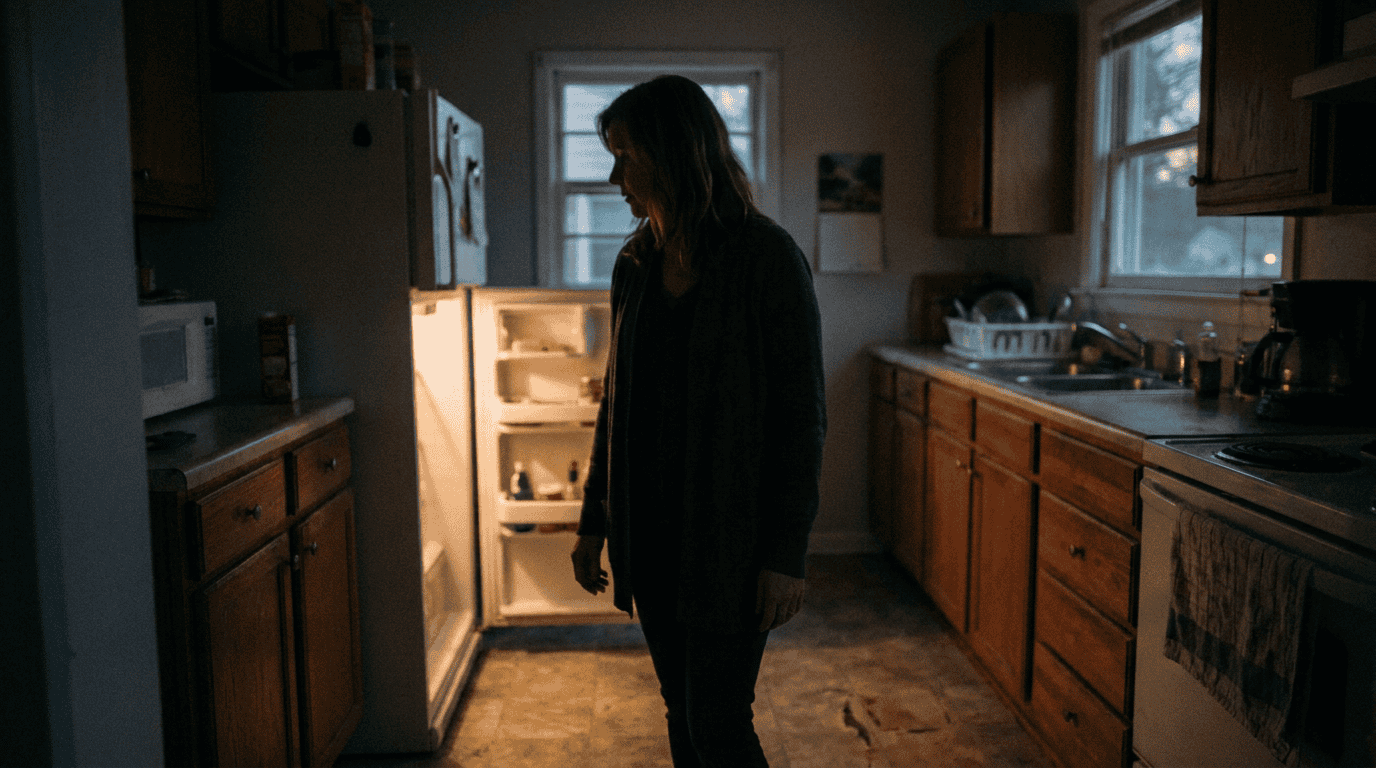
It’s 6:04 p.m. and someone has just asked what’s for dinner. Not a hard question. You’ve answered it several thousand times. Tonight it lands like a pop quiz you didn’t study for, and you stand in front of the fridge for a full minute before you say “I don’t know, you pick,” which is its own kind of answer.
This has a name: decision fatigue. By the time dinner comes up, you’ve already spent most of today’s supply on choices that don’t get counted — which email to answer first, which meeting to push, whether that tone in the group chat needed a reply or just needed ignoring, what to do about the school form due tomorrow. None of them felt like “a decision” on its own. Add them up and it’s no wonder the dinner question is the one that breaks you. You’re not indecisive. You’re out.
The short answer: decision fatigue is a real, measurable drop in the quality of your choices after a long run of deciding — not a character flaw, not proof you’re disorganized. Researchers have watched it happen in professionals whose choices are about as high-stakes as it gets, and it follows a predictable pattern: sharper decisions early, worse ones later, and a reset after rest.¹ The fix isn’t forcing more willpower into a depleted evening. It’s cutting how many decisions are still waiting for you when you get there.
Key takeaways
- Decision fatigue is a documented drop in decision quality after many choices — not a personal failing.¹
- A study of parole judges found favorable rulings fell from about 65% to near zero across a session, then jumped back to about 65% after a break.¹
- Making choices draws on the same limited resource as self-control, so a day full of small decisions leaves less for the big one at the end.²
- It shows up as avoiding a choice, defaulting to the easiest option, or snapping at a question that isn’t really the problem.
- Capping the evening’s decisions at three, and letting the rest run on default, protects the ones that matter.
In this article: Why deciding gets harder by evening · Is this actually measurable · What it looks like · Why it hits the default decider hardest · Cap tonight’s decisions · FAQ
Why does deciding get harder as the day goes on?
Because choosing draws on the same limited resource your brain uses for self-control, and that resource runs down with use, not just with time. In a set of studies, people who’d spent the morning making choices — between products, between course options, between anything — went on to show measurably worse self-control afterward: less patience with a hard task, more procrastination, worse performance on simple arithmetic, even less tolerance for something as small as a bad-tasting drink.² The choices themselves weren’t difficult. It was the sheer count of them that mattered.
That’s the part that doesn’t show up on a calendar. Nobody schedules “decide whether this text needs a reply” or “decide if we’re out of milk or just low.” Those micro-choices don’t feel like work while they’re happening. They still spend the same resource as the decisions you’d actually call decisions, which is why a day that looked unremarkable on paper can still end with you unable to focus on the one email that’s been sitting open since 2 p.m.
Is decision fatigue actually measurable, or does it just feel that way?
It’s measurable, and the clearest evidence comes from an unlikely place: an Israeli parole board. Researchers tracked more than 1,100 parole rulings made by experienced judges over ten months and found a striking pattern — the percentage of favorable rulings started around 65% at the beginning of a session, dropped gradually toward nearly zero as the session wore on, then jumped back up to about 65% right after the judges took a food break.¹ The prisoners’ cases weren’t getting weaker as the morning went on. The judges’ capacity to weigh them carefully was.
What makes the finding land is what it rules out. These were trained professionals making consequential decisions, not tired parents choosing a takeout order. If deciding well enough to grant parole gets harder purely from the accumulation of decisions — regardless of how important each one is — then a day built from hundreds of smaller choices was never going to leave you sharp for the one at 6 p.m. That’s not a knock on your discipline. It’s what the data says happens to anyone’s judgment on a long enough string of decisions.
If the exhaustion isn’t really about dinner — if it’s the whole day’s worth of deciding for everyone — the Quiet Audit is ten minutes on where that load actually sits. Start here.
What does decision fatigue actually look like in real life?
Definition: decision fatigue is the deteriorating quality of a person’s decisions after a long session of decision-making, distinct from ordinary tiredness because it targets judgment specifically, not just energy.
Ordinary tiredness makes everything feel harder. Decision fatigue is narrower and easier to miss, because it doesn’t always look like exhaustion — sometimes it looks like the opposite. It can show up as reaching for the default option without weighing it (the usual order, the usual answer, the usual yes), as avoiding a choice entirely and handing it to someone else, or as a flash of irritation at a question that’s perfectly reasonable but arrives as the two-hundredth ask of the day.
| Ordinary tiredness | Decision fatigue |
|---|---|
| Low energy across the board | Specifically worse judgment on choices, even with energy left for other things |
| Eases with rest or sleep | Eases with a break from deciding — food, rest, or fewer choices next |
| “I’m tired” | “I don’t care anymore, just pick” |
| Builds gradually across a day | Can appear within a single long session of choices |
If you recognize the right-hand column more than the left, the question worth asking isn’t what’s wrong with me tonight. It’s how many decisions did I actually make before this one arrived — most of the time, that number is higher than it looks.
Why does this land harder if you’re the one everyone else asks first?
Decision fatigue isn’t evenly distributed. It concentrates on whoever’s holding the most open questions at once, and in a lot of households and teams, that’s still one person by default — the one who gets asked what’s for dinner, what time practice starts, whether the reply to the client can wait, and whether the thing on the counter is trash or a receipt someone still needs. Each question is small. Being the answer key for all of them is not.
That’s a different load than simply having a full calendar. A calendar tells you what’s coming. Being the default decider means every unscheduled question routes to you too, all day, on top of whatever else you were already deciding — which is a close cousin of the invisible tracking work that doesn’t show up on anyone’s to-do list but yours. The parole judges in the research above had one job and one queue. Most people carrying decision fatigue by evening have several queues running at once, feeding into the same limited resource.
Naming that isn’t an excuse to hand over every decision to someone else, though for the record, redistributing a few of them is a completely reasonable response. It’s a reason to stop treating the 6 p.m. blank-out as a personal failure. You didn’t run out of resolve. You ran out of a resource that had several dozen small withdrawals against it before dinner even came up.
How do I get through an evening of decisions without the shutdown?
Cap tonight’s decisions at three. When you notice the fatigue landing — the fridge stare, the “you pick,” the irritation at a fair question — pick the three decisions from the rest of the evening that actually need your judgment. Dinner might be one. Tomorrow’s one real commitment might be another. Everything else gets a default: the same thing you did yesterday, the easiest true option, or a flat “not tonight.” This isn’t lowering your standards. It’s spending the judgment you have left on the three things that need it instead of spreading it thin across forty things that don’t.
Write the three down if you can — on paper, in your phone, it doesn’t matter. The act of naming them is what lets everything outside that list run on autopilot without you relitigating each one. If even three feels like too many on a genuinely hard day, one is still enough: pick the single decision that matters most tonight, and let the fridge, the group chat, and the form due tomorrow wait for a version of you with more to spend.
Frequently asked questions
Is decision fatigue a real medical diagnosis?
No — it’s a well-documented psychological pattern, not a clinical diagnosis. That doesn’t make it less real; it’s been measured in controlled studies and in real-world professional decisions, just not classified as a medical condition.
Does it get worse with age or in perimenopause?
The core research on decision fatigue wasn’t done specifically on midlife women, so it would be overreaching to claim a direct link. What’s fair to say is that fatigue, disrupted sleep, and a heavier decision load all compound each other, and several of those tend to increase in this decade of life.
Will coffee fix it?
Caffeine can help with general alertness, but the research on choice-draining self-control doesn’t point to caffeine as a reliable fix for judgment specifically. Reducing the number of decisions works more directly than trying to power through more of them.
Why do I make worse decisions late at night specifically?
Night decisions usually arrive last in a long queue of smaller ones made all day, so they’re not actually about night — they’re about being at the end of the line, whatever time that happens to be.
Should I make big decisions earlier in the day?
When you have the choice, yes. The judges in the parole study made their best calls early in each session and their worst right before a break — the same logic applies to anything that genuinely matters to you.
Can decision fatigue affect big life decisions too?
The research is strongest on decisions made within one stretch of time, like a work session or a shopping trip, rather than decisions spaced weeks apart. The safer takeaway isn’t that fatigue ruins major life choices directly — it’s that making a big decision at the tail end of a long day of small ones is worse conditions than making it fresh, so where you can, give it the morning instead of the leftover evening.
The second sentence in the aisle, the one asking what is wrong with you today, costs more than the decision ever did. It helps to know why a sentence about you reads as evidence when a sentence about cereal does not.
If you want the next quiet step
There’s a short, private audit that names what’s actually filling up the decision queue before dinner ever comes up. And if the exhaustion isn’t the deciding but the remembering — the appointments, the forms, the things only you seem to track — that’s a different kind of load, and it has its own name.
The fridge doesn’t need your best thinking. Save that for the three things tonight that actually do.
Decision fatigue is one way a long day catches up with you. Waking up already bracing for the next thing is another, and we looked at why the calm days can feel the most unsettling.
Read next: deciding is not the only thing that runs down over a day. If everything got delivered and you are still wrecked at six, there is a 2008 study that explains the bill.
References
1. Danziger, S., Levav, J., & Avnaim-Pesso, L. Extraneous factors in judicial decisions. PNAS, 2011. pubmed.ncbi.nlm.nih.gov/21482790 (Danziger: Scholar. Levav: Scholar · LinkedIn. Avnaim-Pesso: ORCID.)
2. Vohs, K.D., et al. Making choices impairs subsequent self-control: A limited-resource account of decision making, self-regulation, and active initiative. Journal of Personality and Social Psychology, 2008. (Wikipedia · Scholar · LinkedIn) pubmed.ncbi.nlm.nih.gov/18444745
Disclosure
This article is informational and is not medical or psychological advice.
We are not clinicians or psychologists. We read the published work and translate it into plain English.
Blue Leaf Journal has no affiliation with, and no endorsement from, any researcher or institution named above.
No commercial relationship exists with any person, institution, book or method mentioned here.
Every quotation and figure above was checked against the primary source on 6 September 2026. Corrections: the comment field below this article reaches the editor. We amend errors in place and note the change and its date here.
On the researcher: the parole-ruling study (Danziger, Levav & Avnaim-Pesso) and the self-control research (Kathleen Vohs and colleagues) are peer-reviewed psychology, not a clinical assessment of any individual’s decision-making.
Written by Claire Bennett for Blue Leaf Journal. Updated: August 9, 2026.