The Hot Flash You Never Felt Still Woke You Up
Body · Sleep at Midlife, Vol. 1 · The Reading Room · 8 min read · The mechanism, the numbers, and what the studies could not measure
Menopause sleep at 3 a.m. is a temperature problem, not a discipline problem. What the thermoregulation research found, and the one nightly move to try.
Based on the published research of
Fiona C. Baker, PhD — Director, Center for Health Sciences and Human Sleep Research Program, SRI International.
Faculty page · SRI Human Sleep Program · Primary paper
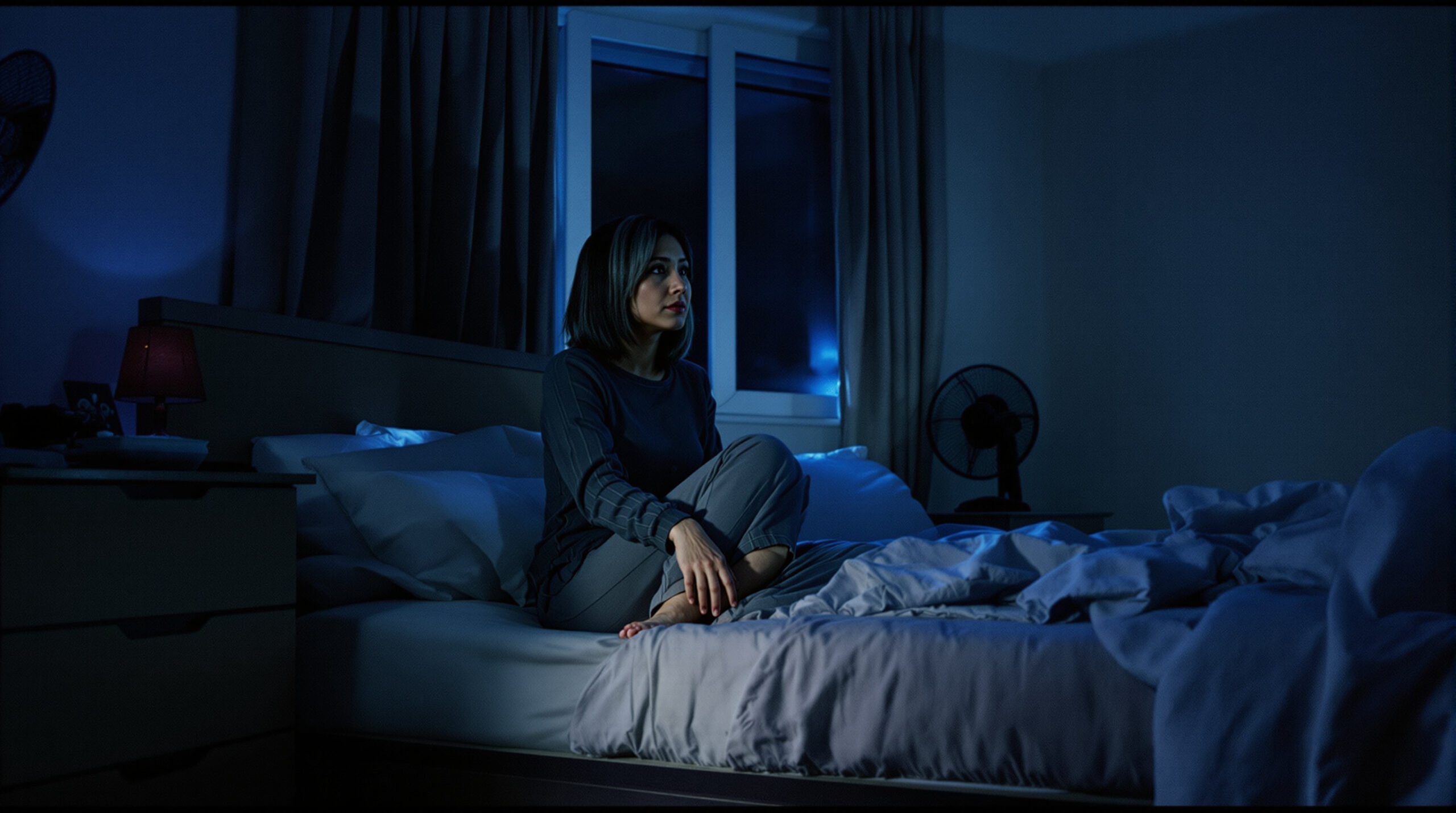
The clock says 2:58. Close enough to 3 a.m., often enough now, that it has stopped reading as coincidence and started reading as an appointment. The duvet is on the floor and you do not remember pushing it there. The room is warmer than when you got in, or you are, and your heart is running slightly faster than lying still explains.
Nothing else is running. No meeting to replay, no argument you are still losing. This is what menopause sleep at 3 a.m. actually looks like, and it is not the thing you have been told it is. Downstairs there is a 7:45 you already moved twice and a 9 a.m. where you will be the only one who has read the deck all the way through. What nobody explains is that the waking has a measured mechanism, and the mechanism is thermal.
The short answer: waking at 3 a.m. in perimenopause is usually a temperature event. The range of body temperature your system tolerates without reacting has narrowed, so small heat rises now cross a line they used to sit inside.
The skim version
- In postmenopausal women with hot flashes, the gap between the sweating and shivering thresholds measured 0.0°C, against 0.4°C in women without them. The buffer is effectively gone.¹
- Wake episodes were recorded alongside 78% of objectively measured night-time hot flashes in 168 midlife women.²
- That waking happened whether or not the woman noticed the flash. You do not have to feel hot for this to be the mechanism.²
- In an experimental model, each additional night-time flash was associated with a 62% rise in measured time awake after falling asleep.³
- Roughly 26% of women in the transition have sleep symptoms severe enough to meet the threshold for insomnia, and the trouble is staying asleep, not starting.⁴
- What none of it measured: whether cooling your bedroom reduces your own 3 a.m. waking. No study here tested that, and none of them names 3 a.m. as an hour.
In this article: Why 3 a.m., and why temperature · Do you have to feel the flash · What the evidence supports · Where this thins out · FAQ
Why does menopause sleep collapse at 3 a.m. and not at bedtime?
Because falling asleep was never the part that broke. The research keeps landing on the same asymmetry: the problem is holding the night, not entering it. Fiona C. Baker, PhD, who directs the human sleep research program at SRI International, has spent two decades measuring this, and her group’s review puts the weight on temperature events.
“A major contributor to sleep complaints in the context of the menopausal transition is HFs [hot flashes], and many, although not all, HFs are linked with polysomnographic-defined awakenings, with HF-associated wake time contributing significantly to overall wakefulness after sleep onset,” Baker and colleagues wrote in Nature and Science of Sleep in 2018.⁴
Read the hedge in that sentence. Many, although not all. The people who study this hardest are the ones least willing to tell you every night waking is a flash.
The thermoneutral zone is the band of core body temperature inside which your body neither sweats to shed heat nor shivers to make it. Inside the band, nothing happens. Cross either edge, and something does.
That band is the whole story. In 1999, Robert R. Freedman, PhD, then at Wayne State University School of Medicine, heated and cooled 20 postmenopausal women in a laboratory to find the exact points where each began sweating and began shivering. In the 12 women with hot flashes, the distance between those thresholds came out at 0.0°C on rectal measurement. In the 8 without, it was 0.4°C.¹
Zero is not a rounding artefact. The sweat response and the shiver response had closed on each other until no neutral territory was left between them. A rise of a tenth of a degree, the kind of drift that happens in ordinary sleep without any cause worth naming, now lands outside the band instead of inside it. Your body reads it as an emergency and dumps heat: vessels open, sweat starts, heart rate lifts. You surface.
What the research found
Freedman, R.R. & Krell, W., American Journal of Obstetrics & Gynecology, 1999. Twelve postmenopausal women with hot flashes and eight without, heated and cooled across three laboratory sessions.
The finding. The interthreshold zone was significantly smaller in the symptomatic women on all three temperature measures. The authors concluded that hot flashes “may be triggered by small elevations in body temperature acting within a reduced thermoneutral zone.”¹
The limitation. Twenty women in total, all postmenopausal rather than mid-transition, warmed and chilled under conditions nothing like a bedroom. It establishes the mechanism. It does not tell you how often that mechanism fires in your own house.
Source box
Night flashes drive a meaningful share of time spent awake. Baker, de Zambotti, Colrain & Bei, Nature and Science of Sleep, 2018. Full text.
Hormone levels track night waking even after flashes are accounted for. Baker, Climacteric, 2023. Full text.
If the hour you are awake gets spent running everyone else’s list, the Quiet Audit is that same list, written down in daylight where you can see the size of it. Start here.
Do you have to feel the hot flash for it to count?
No, and this is the finding that changes what you do next. In 2019, Rebecca C. Thurston, PhD, and colleagues at the University of Pittsburgh monitored 168 peri- and postmenopausal women at home for 24 hours: skin conductance sensors on the sternum to catch flashes, actigraphy to catch sleep. Then they compared the minutes during each flash against the minutes just before it.
Wake episodes were recorded alongside 78% of the objectively measured night-time flashes. The odds of being awake in the five minutes from flash onset ran more than five times higher than in the ten minutes leading up to it. And then the line that matters most: “The increased likelihood of wake occurred irrespective of whether the women reported the objective hot flash.”²
The sensor saw the flash. The woman did not. She woke anyway.
Your range narrowed. Your discipline did not.
The absence of a dramatic symptom is what sends women looking for a character explanation. No sweat, no flushed face, so it must be stress, or age, or the slow discovery that you have become someone who cannot sleep. The measurement says otherwise. A flash below the threshold of noticing still ends the sleep stage you were in.
| A temperature waking | A thinking waking |
|---|---|
| You come up warm, or damp, or with a pulse slightly too quick, and no story attached | You come up with a sentence already in progress |
| The bedding is pushed off before you are conscious of doing it | The bedding is where you left it |
| It eases as you cool, on a timescale of minutes | It eases once the thought is written down with a next step attached |
| A cooler room changes the night | A cooler room changes nothing |
Both are real, and the same woman gets either on different nights. They do not answer to the same fix, which is why advice built for one reads as useless when you are living the other. The grogginess that follows has its own cost: the fog that arrives the next afternoon runs on much of the same curve.
What does the evidence actually support?
Cooling. Freedman’s review of the mechanism states that peripheral cooling ameliorates hot flashes.⁵ That is a claim about flashes, not about your 3 a.m. waking, and the distance between those two is where honest advice lives. Cooling targets the trigger the laboratory work identified. Whether it buys back the night is not something these studies measured.
Cognitive behavioural therapy for insomnia. Baker’s 2023 review in Climacteric describes it as “effective and durable in treating menopausal insomnia.”&sup6; It is a structured course of several weeks with a trained provider, not a technique you run tonight, and it is the best-supported option that does not involve a prescription.
Hormone therapy. The same review notes that it alleviates sleep disturbance, “particularly in the presence of disruptive vasomotor symptoms.”&sup6; That is a conversation with a clinician who knows your history and your risk profile, not a conclusion to reach from an article, this one included.
What has no support here is the bedtime-hygiene apparatus aimed at falling asleep. You fell asleep fine. Aiming at the wrong end of the night is why it has felt like nothing works, and the gap between exhaustion and wakefulness has its own separate mechanism.
Who else has measured this
Robert R. Freedman, PhD, Wayne State University School of Medicine. Established the narrowed thermoneutral zone as the trigger, and later described flashes as accounting for “some, but not all, of the sleep disturbance reported during menopause.”⁵ Paper · Wayne State research news · Wayne State lecture. He discloses a commercial interest in a hot flash recording device.
Rebecca C. Thurston, PhD, Pittsburgh Foundation Chair in Women’s Health and Dementia, University of Pittsburgh. Found wake episodes alongside 78% of objectively recorded night flashes in 168 women, reported or not.² Faculty page · Paper · Google Scholar · UPMC expert profile · University news · Society for Women’s Health Research · LinkedIn.
Hadine Joffe, MD, Paula A. Johnson Professor of Psychiatry in the Field of Women’s Health, Brigham and Women’s Hospital. Induced a temporary menopausal state in 29 women; each additional night flash tracked a 62% rise in measured time awake.³ Faculty page · Paper · Google Scholar · Brigham physician profile · Aspen Ideas speaker page · YouTube talk · LinkedIn.
Howard M. Kravitz, DO, MPH, Rush University Medical Center, principal investigator for the Chicago site of the Study of Women’s Health Across the Nation. Tracked 1,285 women; waking several times a night was the most prevalent sleep problem, with 18.4% in a persistently high-prevalence group.⁸ Faculty page · Paper · ORCID · Rush research profile.
What to say at the appointment
“I am waking between two and four most nights and I cannot get back down. Falling asleep is not the problem. It started around the time my cycle changed.”
The terms that get you taken seriously: nocturnal vasomotor symptoms and sleep maintenance insomnia. Then ask whether it is worth ruling out sleep apnoea or a thyroid change first.
Go sooner, not later, if someone has heard you snore loudly or stop breathing, if you are falling asleep during the day, if the waking arrived suddenly, or if it comes with chest pain or breathlessness. Sleep-related breathing disorders become more common after menopause and are treated differently.
Frequently asked questions
Is waking at 3 a.m. every night normal in perimenopause?
Common, and measured. Around 26% of women in the transition report sleep symptoms severe enough to meet an insomnia threshold, and difficulty staying asleep is the dominant pattern.⁴ Common does not mean untreatable. It means you are not malfunctioning.
Why 3 a.m. and not some other hour?
The research does not say. These studies measure how much you are awake and how often, not what the clock reads. The hour is probably yours rather than universal, set by when you fell asleep and where your flashes land in the night.
Does hormone therapy fix this?
Reviews report that it alleviates sleep disturbance, most clearly when disruptive vasomotor symptoms are present.&sup6; Whether it suits you depends on your history and risk profile, which is a clinician’s conversation and not something an article can settle.
Could this be something other than temperature?
Yes. Sleep apnoea, restless legs, thyroid changes and several common medications all cause similar waking and all become more frequent in these years. Hormone levels also track night waking on their own, separately from flashes.&sup6;
Where this evidence thins out
The mechanism study is small. Twenty women, all postmenopausal, heated and cooled in a laboratory. It shows the thermoneutral zone narrows. It does not show how often that produces a waking in an ordinary bedroom.¹
The strongest causal evidence is not from women your age. Joffe’s model, the one design here that can speak to cause rather than coincidence, used 29 healthy women averaging 27 years old whose menopause was induced with a drug for four weeks.³ A clean experiment, and a real distance from a 48-year-old in year three of a transition.
The 78% figure is co-occurrence, not proof of cause. Thurston’s design compares the minutes during a flash against the minutes before it, which points strongly at direction, but it stays observational, and actigraphy infers sleep from movement rather than reading the brain directly.²
The field disagrees with itself. Baker and her co-authors say so plainly: “Findings from polysomnographic studies are less consistent in showing disrupted sleep in menopausal transition independent of aging; further prospective studies are needed.”⁷ What women report and what the laboratory records do not always line up.
And nobody tested the advice. None of these studies asked whether dropping your bedroom temperature reduces your night waking. Cooling is reasoned from the mechanism, not demonstrated against the outcome. That gap is real, and you should know you are standing in it.
About the researcher
Fiona C. Baker, PhD directs the Center for Health Sciences and the Human Sleep Research Program at SRI International, where she has worked since 2005. Her doctorate is in physiology, from the University of the Witwatersrand in Johannesburg, where she keeps an affiliation with the Brain Function Research Group. Her work covers sleep physiology across the lifespan with a focus on women, including sex differences in sleep and the insomnia that develops during the menopausal transition. She is a physiologist and sleep scientist, not a physician. Faculty page · Google Scholar · ResearchGate · Loop (Frontiers) · SRI press feature · Contemporary OB/GYN interview · LinkedIn.
On the researcher. Fiona Baker is a physiologist and sleep scientist, not a physician; her own review calls the polysomnographic evidence on menopausal sleep disruption “less consistent,” and this article does not go further than what she and her co-authors state.
Disclosure
This article is informational and is not medical advice.
We are not clinicians. We read the papers and translate them; the findings belong to Dr. Baker and colleagues at SRI International, and the plain-English version is ours.
Blue Leaf Journal has no affiliation with, and claims no endorsement from, Fiona C. Baker, Robert R. Freedman, Rebecca C. Thurston, Hadine Joffe, Howard M. Kravitz, or their institutions. None of them reviewed this article.
No commercial relationship exists with any product, provider or treatment named here, and nothing on this page is paid placement. Dr. Freedman’s own commercial interest in a hot flash recording device is disclosed above.
Every figure and quotation here was checked against the primary source on 2 September 2026. If you find an error, tell us through the contact page and we will correct it and date the correction.
Waking at the same hour every night is a sleep-architecture problem before it is a worry problem, and the architecture is what the transition alters: how the transition rewires sleep and next-day thinking.
The one move
Tonight, when you set your alarm, drop the room a couple of degrees and get into bed slightly too cool rather than comfortably warm. You adjust upward faster than you adjust down at 3 a.m. Attach it to the alarm so it happens without deciding.
There is also a short, private audit of what you carry into the night besides your own temperature: the deadlines, the tally, the list nobody else knows you are keeping. Ten minutes, no programme. Start here.
Informational, not medical advice. See your clinician about sleep changes that are severe, sudden, or arriving with other new symptoms.
If what wakes you is your own heartbeat rather than the heat, that has separate research behind it: what the SWAN data showed about palpitations in this decade.
The clock will say 2:58 again some night. Your thermostat has a narrower range than it used to, that is all, and the room is something you can change before you get in.
References
1. Freedman, R.R. & Krell, W. Reduced thermoregulatory null zone in postmenopausal women with hot flashes. American Journal of Obstetrics & Gynecology, 1999;181(1):66–70. pubmed.ncbi.nlm.nih.gov/10411797
2. Thurston, R.C., Chang, Y., Buysse, D.J., Hall, M.H. & Matthews, K.A. Hot flashes and awakenings among midlife women. Sleep, 2019;42(9):zsz131. pmc.ncbi.nlm.nih.gov/articles/PMC7368339
3. Joffe, H., Crawford, S., Economou, N., Kim, S., Regan, S., Hall, J.E. & White, D. A gonadotropin-releasing hormone agonist model demonstrates that nocturnal hot flashes interrupt objective sleep. Sleep, 2013;36(12):1977–85. pmc.ncbi.nlm.nih.gov/articles/PMC3825449
4. Baker, F.C., de Zambotti, M., Colrain, I.M. & Bei, B. Sleep problems during the menopausal transition: prevalence, impact, and management challenges. Nature and Science of Sleep, 2018;10:73–95. pmc.ncbi.nlm.nih.gov/articles/PMC5810528
5. Freedman, R.R. Menopausal hot flashes: mechanisms, endocrinology, treatment. Journal of Steroid Biochemistry and Molecular Biology, 2014;142:115–20. pmc.ncbi.nlm.nih.gov/articles/PMC4612529
6. Baker, F.C. Optimizing sleep across the menopausal transition. Climacteric, 2023;26(3):198–205. pmc.ncbi.nlm.nih.gov/articles/PMC10416747
7. Baker, F.C., Lampio, L., Saaresranta, T. & Polo-Kantola, P. Sleep and sleep disorders in the menopausal transition. Sleep Medicine Clinics, 2018;13(3):443–456. pmc.ncbi.nlm.nih.gov/articles/PMC6092036
8. Kravitz, H.M., Janssen, I., Bromberger, J.T., Matthews, K.A., Hall, M.H., Ruppert, K. & Joffe, H. Sleep trajectories before and after the final menstrual period in the Study of Women’s Health Across the Nation (SWAN). Current Sleep Medicine Reports, 2017;3(3):235–250. pmc.ncbi.nlm.nih.gov/articles/PMC5604858
Nora Whitfield writes the Body desk at Blue Leaf Journal: what is happening in the tissue, what the research actually says, and what to ask for by name. Written by Nora Whitfield for Blue Leaf Journal. Updated: 2 September 2026.